<?xml version="1.0" encoding="utf-8"?><feed xmlns="http://www.w3.org/2005/Atom" ><generator uri="https://jekyllrb.com/" version="4.3.4">Jekyll</generator><link href="https://peerllm.github.io/feed.xml" rel="self" type="application/atom+xml" /><link href="https://peerllm.github.io/" rel="alternate" type="text/html" /><updated>2026-05-04T05:25:39+00:00</updated><id>https://peerllm.github.io/feed.xml</id><title type="html">PeerLLM Blog</title><subtitle>A blog about PeerLLM and related topics in machine learning and AI.</subtitle><entry><title type="html">PeerLLM v1.7.1: Optimizing Host Performance</title><link href="https://peerllm.github.io/2026/05/03/v1.7.1-announcement.html" rel="alternate" type="text/html" title="PeerLLM v1.7.1: Optimizing Host Performance" /><published>2026-05-03T00:00:00+00:00</published><updated>2026-05-03T00:00:00+00:00</updated><id>https://peerllm.github.io/2026/05/03/v1.7.1-announcement</id><content type="html" xml:base="https://peerllm.github.io/2026/05/03/v1.7.1-announcement.html"><![CDATA[<h2 id="0-introduction">0/ Introduction</h2>

<p>This release is focused on making your machine perform at its highest potential within the network.</p>

<p>The goal here is not to introduce surface-level features, but to ensure that when your host participates in PeerLLM, it does so in a way that is consistent, efficient, and aligned with the expectations of a distributed system. This means improving how your machine decides, how it allocates resources, and how it behaves under real load conditions.</p>

<hr />

<h2 id="1-finding-the-best-configuration-for-your-machine">1/ Finding the Best Configuration for Your Machine</h2>

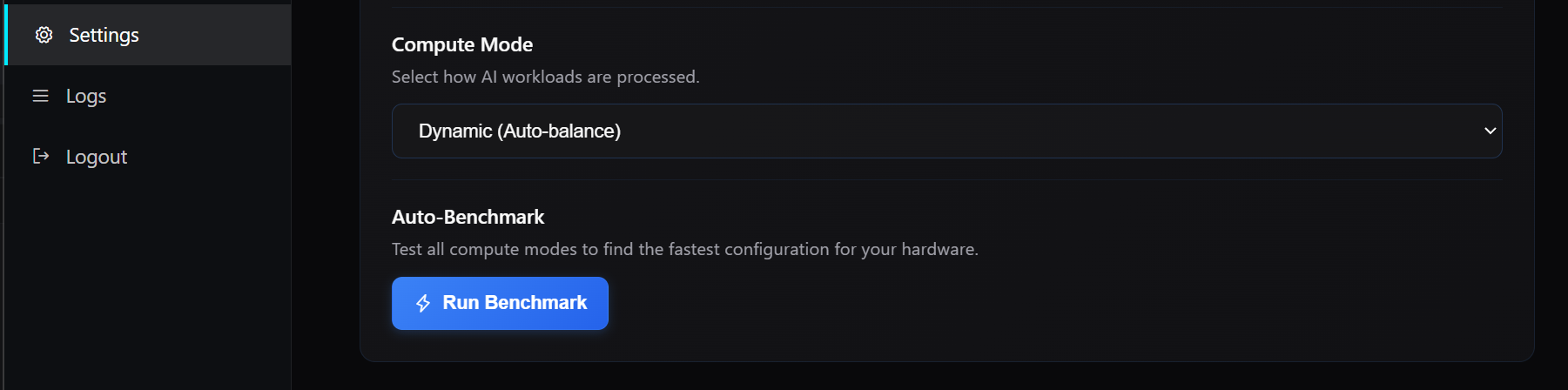
<p>One of the most important additions in this release is the introduction of an Auto-Benchmark system that allows your machine to determine its optimal configuration based on actual performance rather than assumptions.</p>

<div class="post-image">
  <img src="/assets/images/v1.7.1-settings-auto-benchmark.png" alt="New UI experience" />
</div>

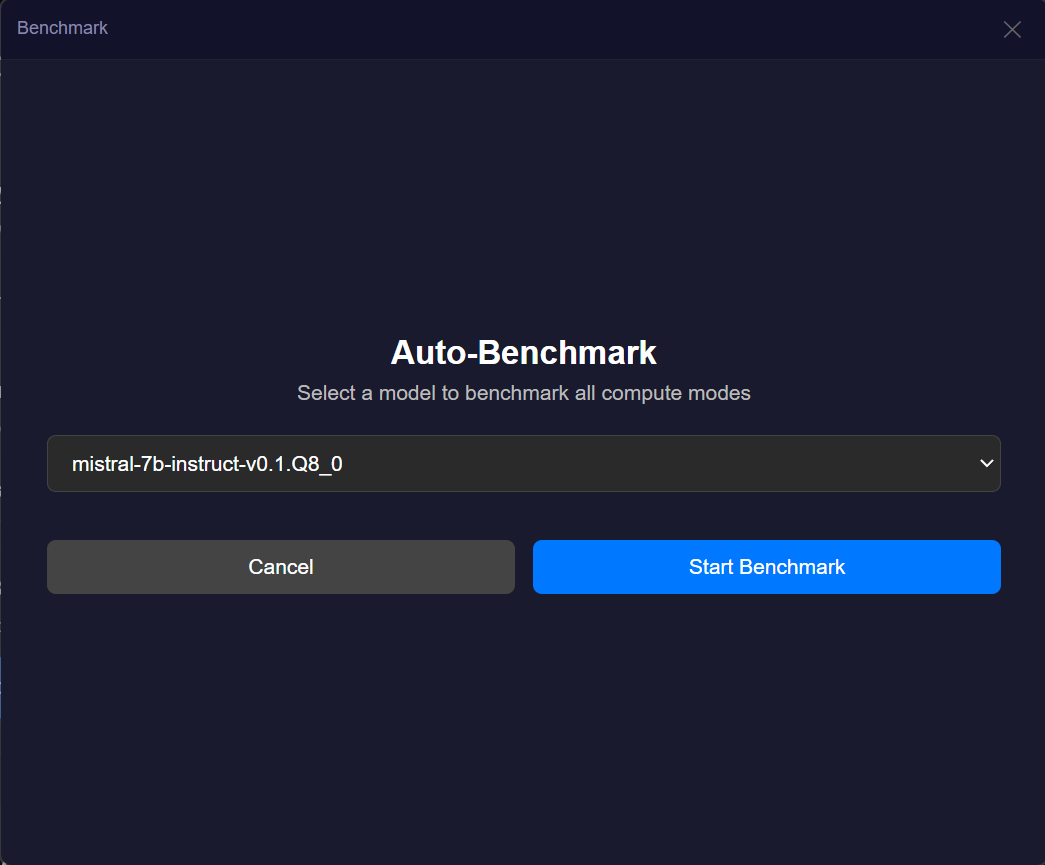
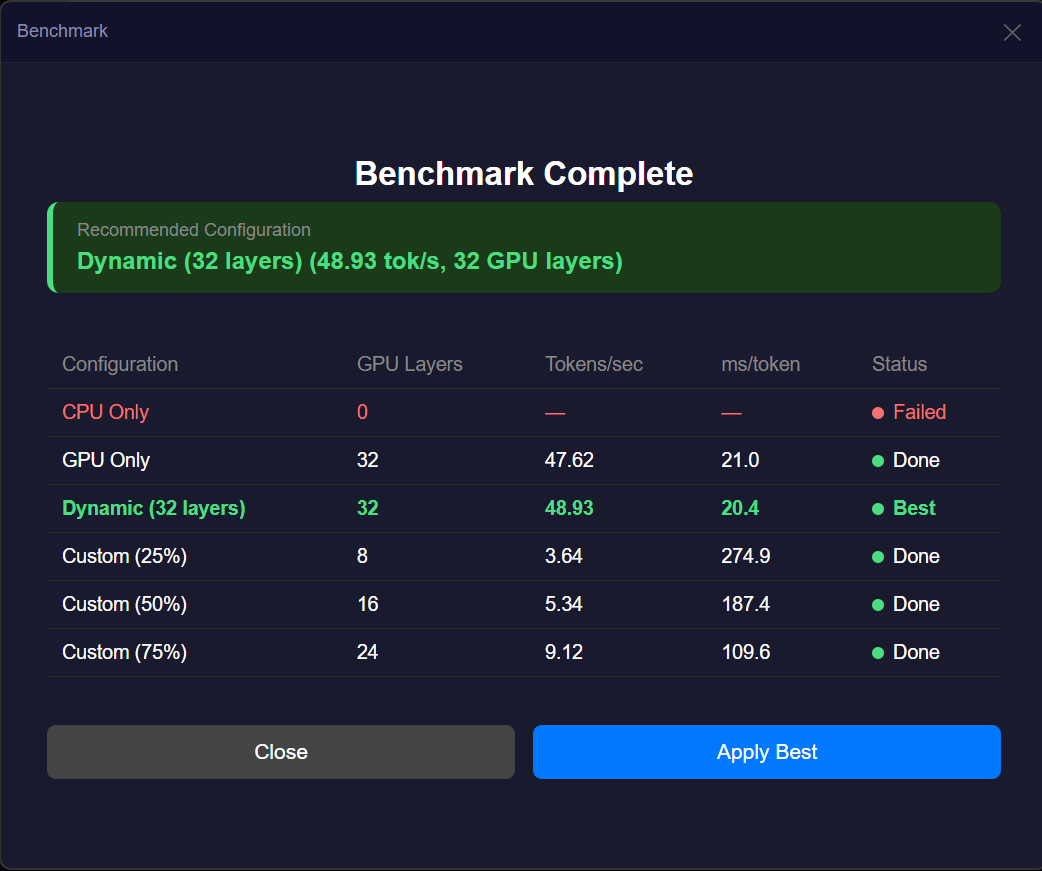
<p>Different machines behave differently depending on their hardware, memory constraints, and compute modes. Instead of relying on static configurations, you can now run a benchmark that evaluates multiple compute modes, including CPU, GPU, dynamic allocation, and custom configurations. The system measures real tokens per second and recommends the configuration that delivers the best performance. Once identified, that configuration can be applied immediately.</p>

<div class="post-image">
  <img width="75%" src="/assets/images/v1.7.1-benchmark-select-llm-dialog.png" alt="New UI experience" />
</div>

<p>This ensures that your host is not operating below its potential and that the network benefits from the most efficient version of your compute.</p>

<div class="post-image">
  <img width="75%" src="/assets/images/v1.7.1-benchmark-results.png" alt="New UI experience" />
</div>

<hr />

<h2 id="2-improving-memory-management-and-sustained-throughput">2/ Improving Memory Management and Sustained Throughput</h2>

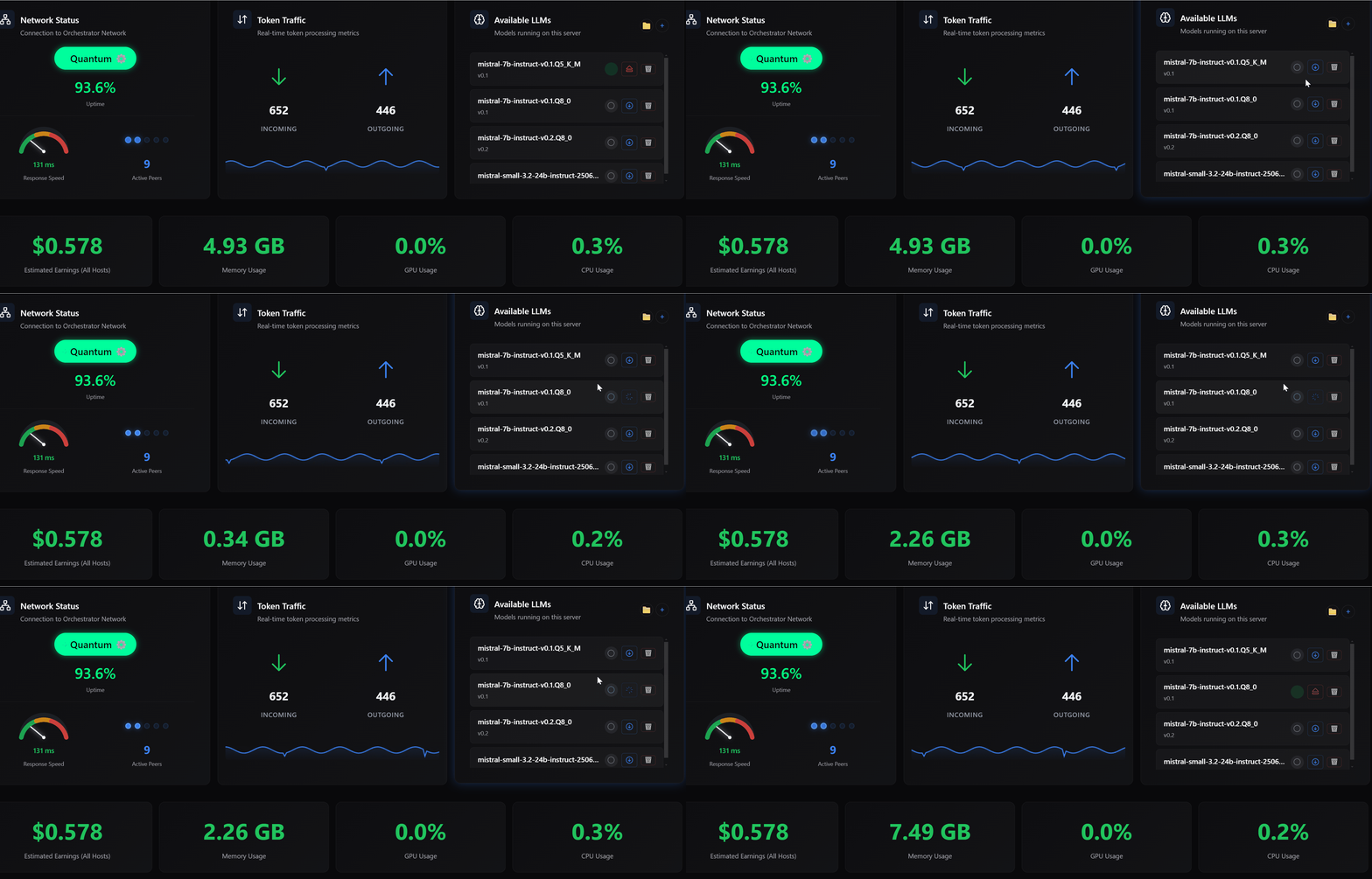
<p>A significant portion of this release is dedicated to improving how memory is managed across the system. Models now transition more cleanly between loaded, active, and idle states, which reduces stale memory usage and improves overall stability.</p>

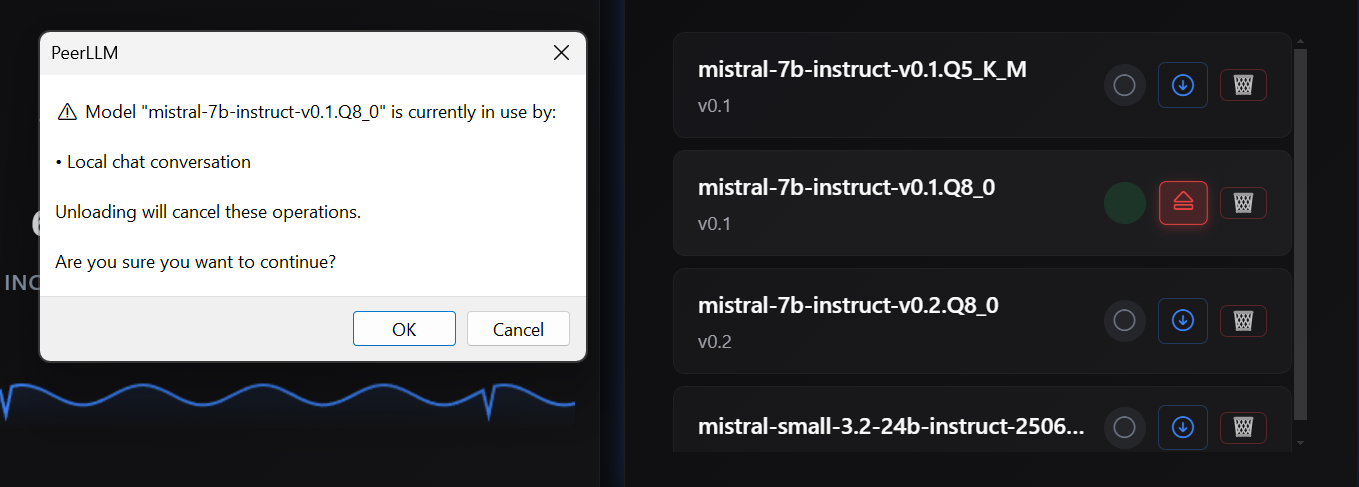
<p>I also introduced mechanisms to validate capacity before execution begins, ensuring that your machine only accepts work it can realistically complete. When changes to memory allocation are required, such as unloading models to make room for new ones, the system now provides clear confirmation rather than making silent decisions.</p>

<p>These changes result in more predictable execution, fewer interruptions, and better sustained throughput over time.</p>

<hr />

<h2 id="3-improving-resource-awareness">3/ Improving Resource Awareness</h2>

<p>For a distributed system to function efficiently, it must have an accurate understanding of the resources available on each participating host. This release improves how your machine reports and interprets its own capabilities.</p>

<p>I enhanced GPU utilization detection across NVIDIA, AMD, and Intel environments, and ensured that the system respects your selected GPU in multi-GPU configurations. Additionally, memory calculations now reflect the actual compute mode being used rather than assuming a fixed allocation model.</p>

<p>These improvements allow the network to make better decisions when routing work, which directly impacts performance, latency, and overall reliability.</p>

<hr />

<h2 id="4-strengthening-execution-decisions">4/ Strengthening Execution Decisions</h2>

<p>This release introduces a more disciplined approach to execution by evaluating whether a request should be accepted before it begins. By validating capacity and readiness ahead of time, the system avoids situations where work starts but cannot be completed.</p>

<p>When a host determines that it cannot fulfill a request, it now communicates this early, allowing the network to reroute the task to another host without delay. This reduces failed executions, improves response consistency, and strengthens the overall behavior of the network under load.</p>

<hr />

<h2 id="5-improving-system-stability-and-predictability">5/ Improving System Stability and Predictability</h2>

<p>Beyond visible features, a large portion of the work in this release focuses on stabilizing the internal behavior of the system. This includes improvements to lifecycle management, background processes, and consistency in how the host operates over time.</p>

<p>While these changes are not directly visible, they play a critical role in ensuring that the system behaves predictably. Hosts remain more consistent in their operation, edge cases are reduced, and overall reliability improves in ways that compound over time.</p>

<hr />

<h2 id="6-improving-communication-from-the-network">6/ Improving Communication from the Network</h2>

<p>Your host now has better visibility into how it is interacting with the network. This includes clearer communication about which models are accepted, how capabilities are interpreted, and when adjustments are made during the registration process.</p>

<p>This reduces ambiguity and allows you to operate your host with a better understanding of how it is being utilized within the network.</p>

<hr />

<h2 id="7-safer-and-more-controlled-defaults">7/ Safer and More Controlled Defaults</h2>

<p>I also made improvements to how the system behaves out of the box, focusing on safer defaults and more controlled interactions. This includes better handling of local services, improved boundaries around execution behavior, and stronger assumptions about how the system should operate in a shared environment.</p>

<p>These changes ensure that new hosts start from a more reliable baseline while still allowing advanced users to configure the system as needed.</p>

<hr />

<h2 id="8-closing">8/ Closing</h2>

<p>PeerLLM is not built on the idea that more features create a better system. It is built on the idea that better behavior creates a stronger network.</p>

<p>This release is a step in that direction. It ensures that each host contributes more effectively, that decisions are made with better information, and that execution across the network becomes more predictable and reliable.</p>

<p>As the network grows, these improvements become foundational. They are what allow PeerLLM to scale not just in size, but in quality.</p>

<p>You can download PeerLLM v1.7.1 <a href="https://hosts.peerllm.com/downloads">here</a>.</p>

<p>~ Hassan</p>]]></content><author><name></name></author><summary type="html"><![CDATA[0/ Introduction]]></summary></entry><entry><title type="html">PeerLLM v1.6.0 Released! Multi-Model, Multi-Chat, and Token Redemption</title><link href="https://peerllm.github.io/releases/peerllm/2026/04/18/v1.6.0-announcement.html" rel="alternate" type="text/html" title="PeerLLM v1.6.0 Released! Multi-Model, Multi-Chat, and Token Redemption" /><published>2026-04-18T00:00:00+00:00</published><updated>2026-04-18T00:00:00+00:00</updated><id>https://peerllm.github.io/releases/peerllm/2026/04/18/v1.6.0-announcement</id><content type="html" xml:base="https://peerllm.github.io/releases/peerllm/2026/04/18/v1.6.0-announcement.html"><![CDATA[<p>I’m excited to ship <strong>PeerLLM v1.6.0</strong> — a release that reshapes how the app handles models, memory, and multi-conversation workflows. This version takes PeerLLM from a single-model runtime to a true multi-model, multi-chat platform, with a rebuilt memory layer underneath to keep everything stable on real hardware.</p>

<p>Here’s what’s new.</p>

<h2 id="0-a-refined-chat-experience">0. A Refined Chat Experience</h2>

<div class="post-image">
  <img src="/assets/images/v1.6.0-chat-center-experience.gif" alt="New UI experience" />
</div>

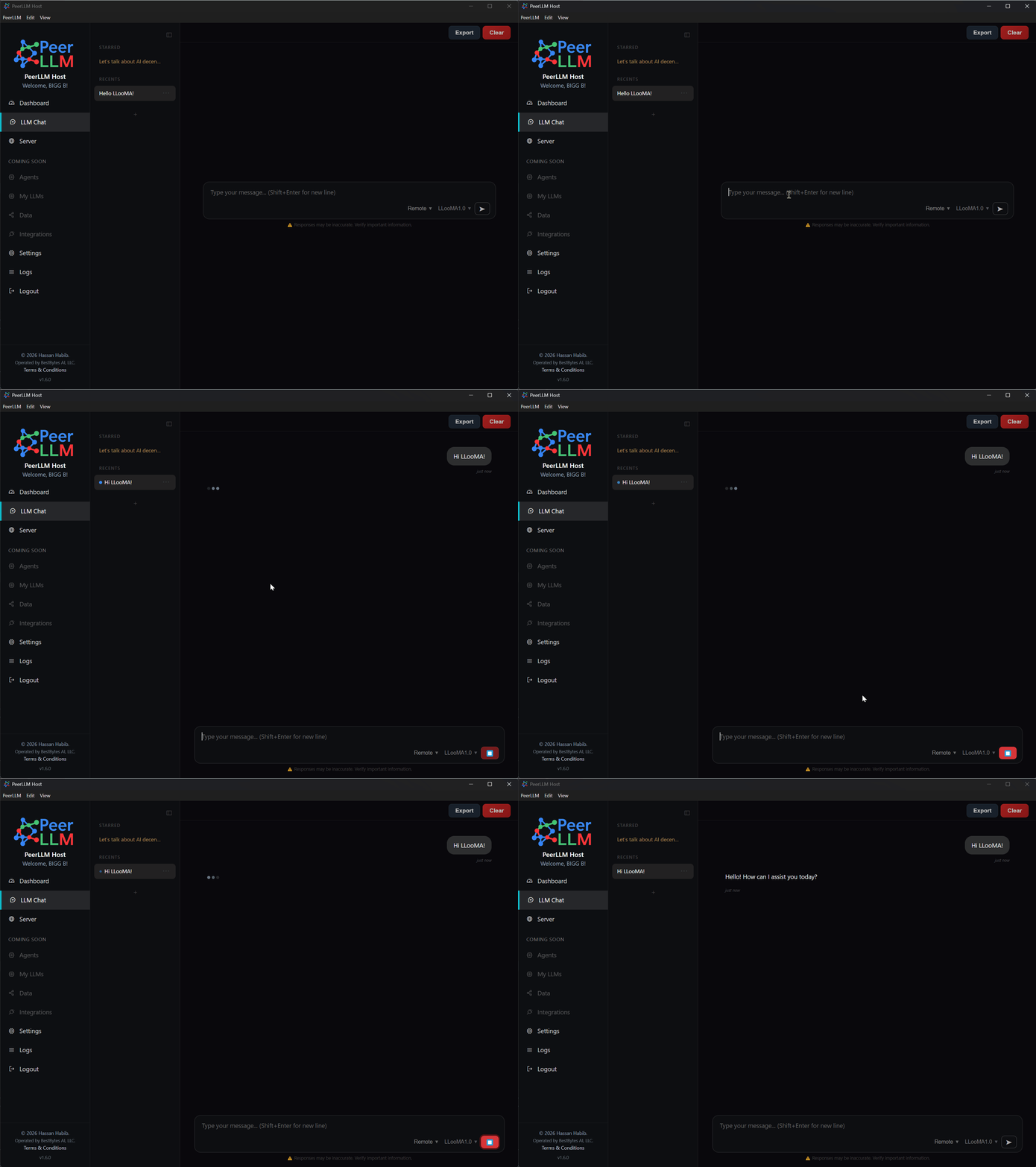
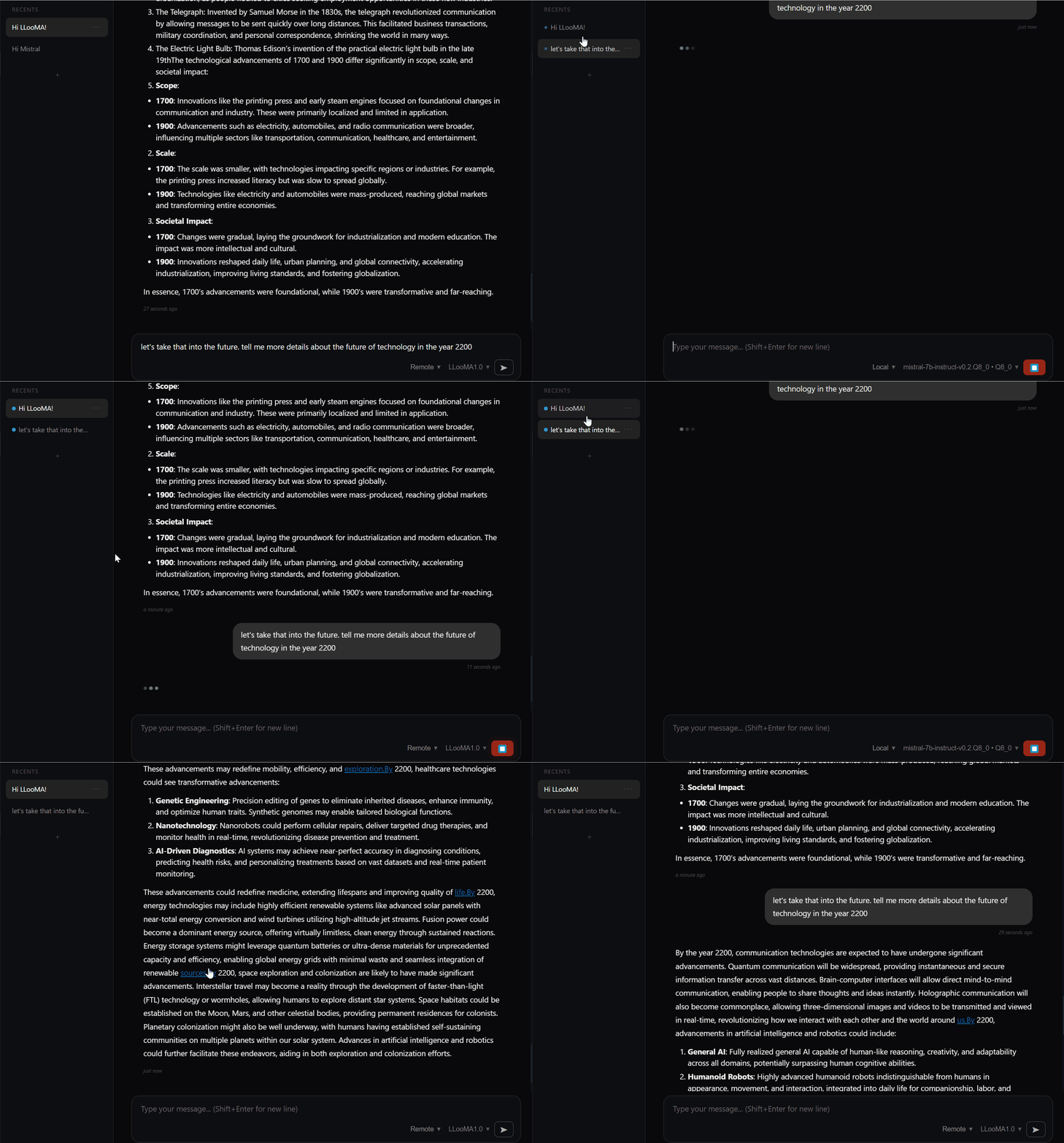
<p>The chat input has been redesigned to feel intentional from the very first moment. When no conversation has started, the input sits centered and ready; once you send your first message, it slides into the standard bottom position. A small polish that makes the “ready to chat” state feel purposeful instead of empty.</p>

<h2 id="1-multiple-chats-at-the-same-time">1. Multiple Chats at the Same Time</h2>

<div class="post-image">
  <img src="/assets/images/v1.6.0-multi-chats-same-time.gif" alt="New UI experience" />
</div>

<p>You can now run several conversations in parallel, each with fully isolated state. Every chat gets its own independent context, so responses always land in the right tab — no cross-talk between conversations. A pulsing indicator on each tab shows you which chats are actively streaming, so it’s easy to keep track of what’s running where.</p>

<h2 id="2-multiple-models-loaded-at-once">2. Multiple Models Loaded at Once</h2>

<div class="post-image">
  <img width="55%" src="/assets/images/v1.6.0-multiple-model-loading.png" alt="New UI experience" />
</div>

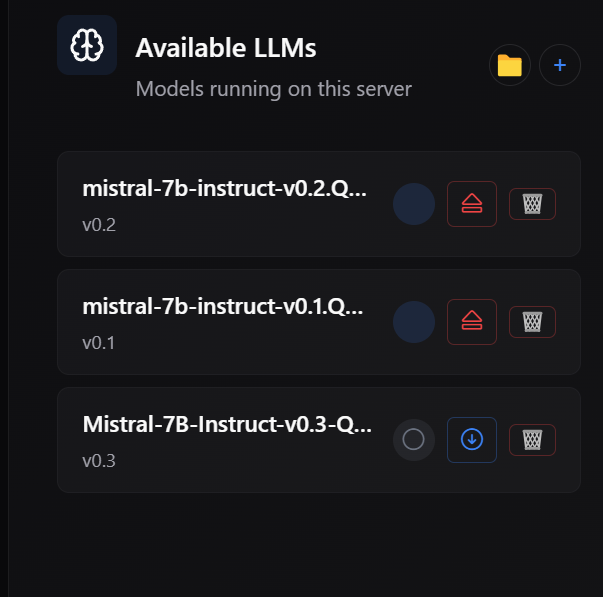
<p>This is the headline feature of v1.6.0. PeerLLM can now hold multiple models in memory simultaneously, routing each conversation to the right one automatically. Switching between models is instant when they’re already loaded, and the app handles all the bookkeeping behind the scenes.</p>

<h2 id="3-smarter-memory-management">3. Smarter Memory Management</h2>

<p>To make multi-model concurrency work reliably, I rebuilt how PeerLLM manages GPU memory:</p>

<ul>
  <li><strong>Pre-flight VRAM checks</strong>: before loading a model, PeerLLM estimates how much VRAM it will need and confirms there’s room. If there isn’t, you get a clear message instead of a silent failure.</li>
  <li><strong>Smart eviction</strong>: when memory gets tight, PeerLLM intelligently unloads idle models to make room, prioritizing auto-loaded models over ones you loaded manually. Active conversations are never interrupted.</li>
  <li><strong>Automatic cleanup</strong>: idle models are released after a period of inactivity so your GPU isn’t holding onto memory you’re not using.</li>
  <li><strong>Clearer error messages</strong>: when something does go wrong, you get actionable guidance like <em>“Model X requires 8 GB but you only have 4 GB free”</em> rather than cryptic errors.</li>
</ul>

<p>I also fixed a number of underlying memory issues that could cause VRAM fragmentation, stuck model states, or runaway context growth over long sessions. The result is a noticeably more stable experience, especially for users running PeerLLM for hours at a time.</p>

<h2 id="4-eviction-warnings">4. Eviction Warnings</h2>

<p>Before automatically unloading a model to make room for a new one, PeerLLM now shows a warning dialog listing exactly which models will be evicted. You can confirm and proceed, or cancel to keep your current setup. No more surprises when working with large models on a single GPU.</p>

<h2 id="5-compute-mode-aware-loading">5. Compute-Mode-Aware Loading</h2>

<p>VRAM checks now respect your compute mode setting. CPU-only mode skips GPU checks entirely, Dynamic mode lets the loader manage layer allocation itself, and GPU-only or Custom modes run full pre-flight validation. Error messages include suggestions tailored to your current mode — for example, recommending a switch to Dynamic mode to enable CPU offloading.</p>

<h2 id="6-required-updates-for-new-hosts">6. Required Updates for New Hosts</h2>

<div class="post-image">
  <img width="55%" src="/assets/images/v1.6.0-latest-required-upon-registration.jpeg" alt="New UI experience" />
</div>

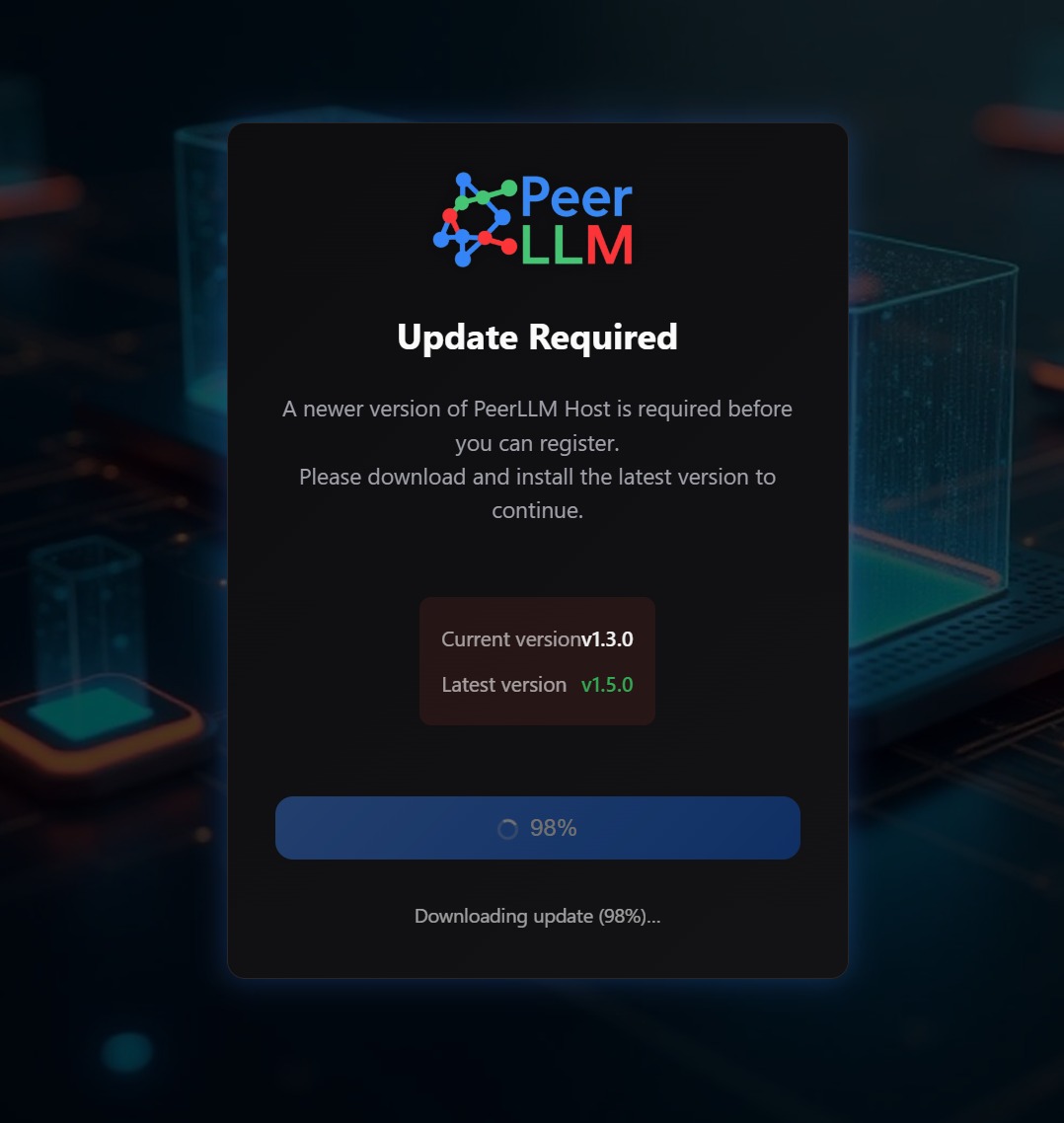
<p>Hosts joining the PeerLLM network are now required to run the latest version. When an outdated host tries to connect, an update prompt appears with a one-click download and install flow. This keeps the host network running on compatible code and makes rolling out improvements much smoother.</p>

<h2 id="7-refreshed-about-window">7. Refreshed About Window</h2>

<div class="post-image">
  <img width="55%" src="/assets/images/v1.6.0-about-window.png" alt="New UI experience" />
</div>
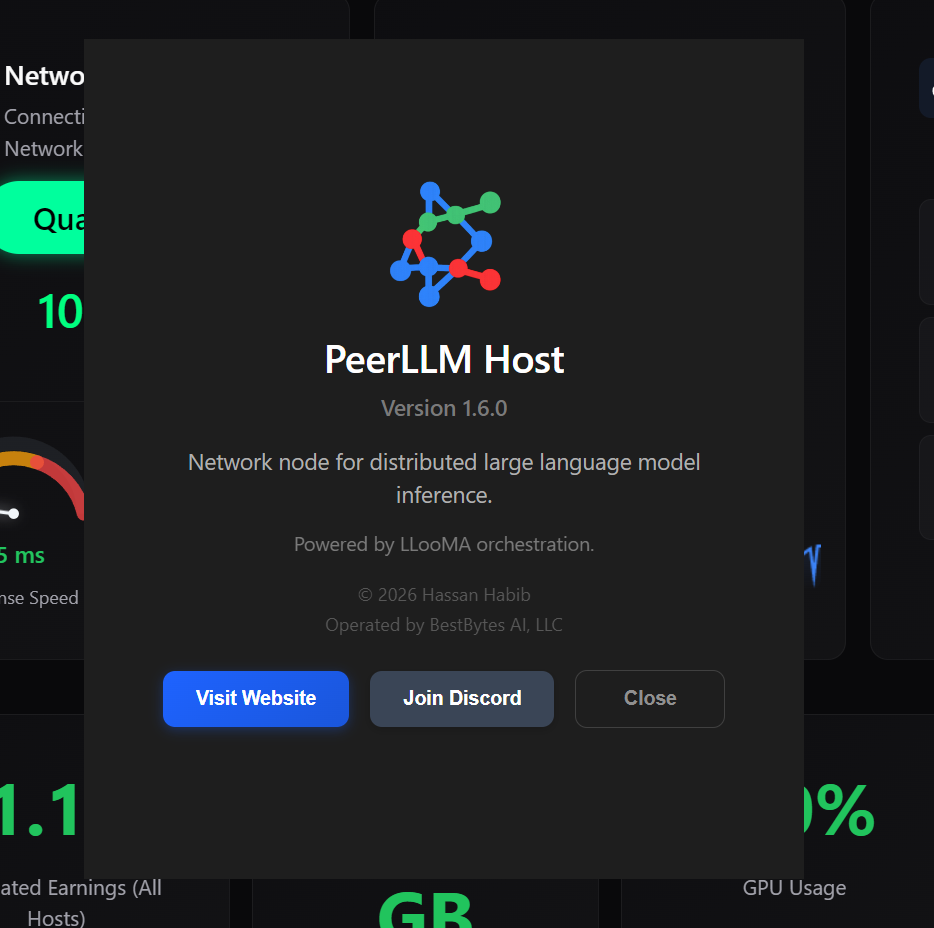
<p>I replaced the default system About dialog with a custom window that better reflects the PeerLLM brand — version info, quick links to the website and Discord, and a cleaner look overall.</p>

<h2 id="8-new-redeem-token-codes-from-the-hosts-portal">8. New: Redeem Token Codes from the Hosts Portal</h2>

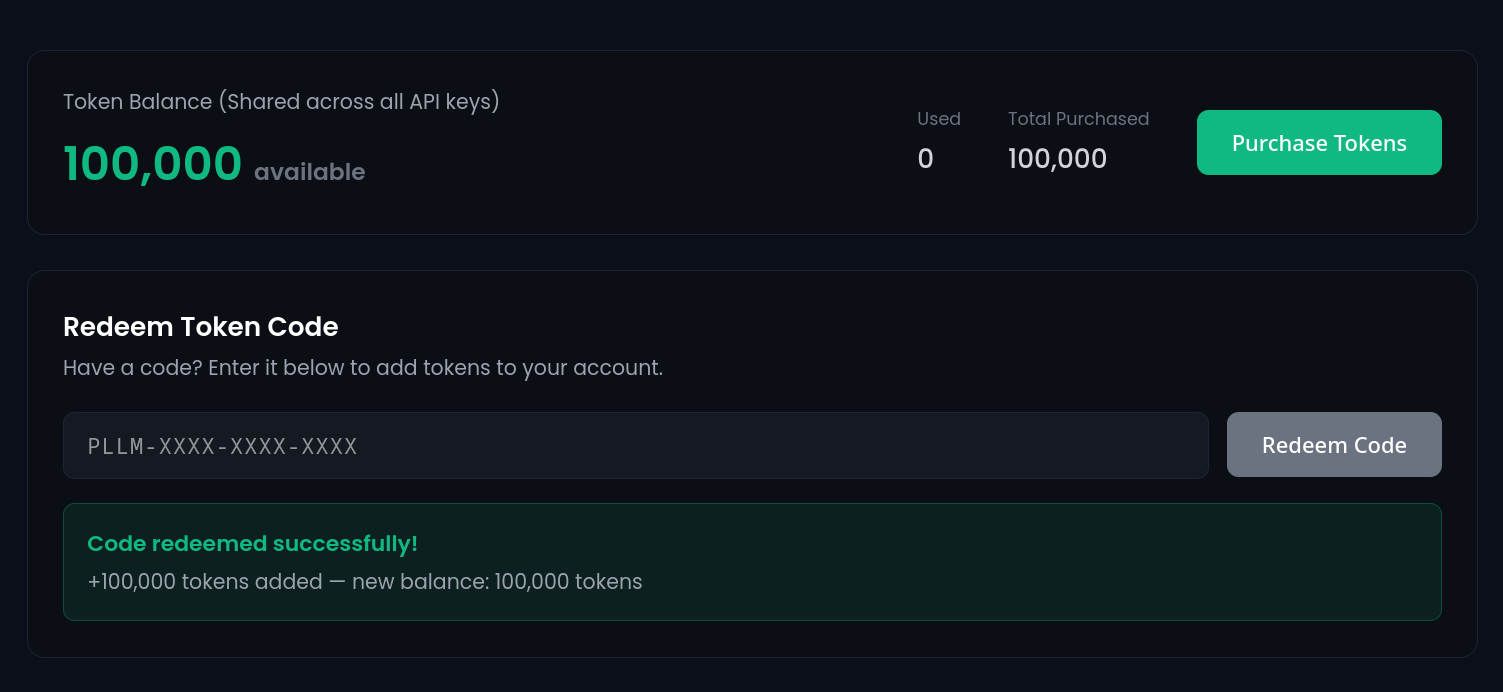
<p>v1.6.0 also introduces a capability I’ve had a lot of requests for: <strong>redeeming token codes directly from the hosts portal</strong>.</p>

<div class="post-image">
  <img width="75%" src="/assets/images/v1.6.0-redeem-tokens.png" alt="New UI experience" />
</div>

<p>If you’ve received a token code — from a campaign, a partner, or a promotional drop — you can now redeem it in the hosts portal to top up your balance and use the <strong>PeerLLM API</strong> right away. No support ticket, no manual account adjustments. Paste the code, confirm, and your tokens are available immediately.</p>

<p>This is the first step in a broader set of portal capabilities I’ll be rolling out over the coming releases.</p>

<div style="border: 2px solid #f59e0b; background: linear-gradient(135deg, #fef3c7 0%, #fde68a 100%); border-radius: 12px; padding: 20px 24px; margin: 24px 0; box-shadow: 0 4px 12px rgba(245, 158, 11, 0.15);">
  <div style="font-size: 1.1em; font-weight: 600; color: #78350f; margin-bottom: 8px;">
    🎁 First Reader Bonus
  </div>
  <p style="margin: 0; color: #451a03; line-height: 1.6;">
    If you are the first person to read this post, here's a free PeerLLM token code as a thank you: <code style="background: #78350f; color: #fef3c7; padding: 4px 10px; border-radius: 6px; font-size: 0.95em; font-weight: 600; letter-spacing: 0.5px;">PLLM-VRK7-PTRD-FYM2</code>
  </p>
</div>

<p>If the code is already redeemed, reach out on Discord and I will give you a free token :-)</p>

<h2 id="9-getting-v160">9. Getting v1.6.0</h2>

<p>Existing users will be prompted to update automatically. New hosts will be required to update before joining the network.</p>

<p>As always, I’d love to hear your feedback — join us on Discord or drop us a note through the portal. Happy inferencing.</p>

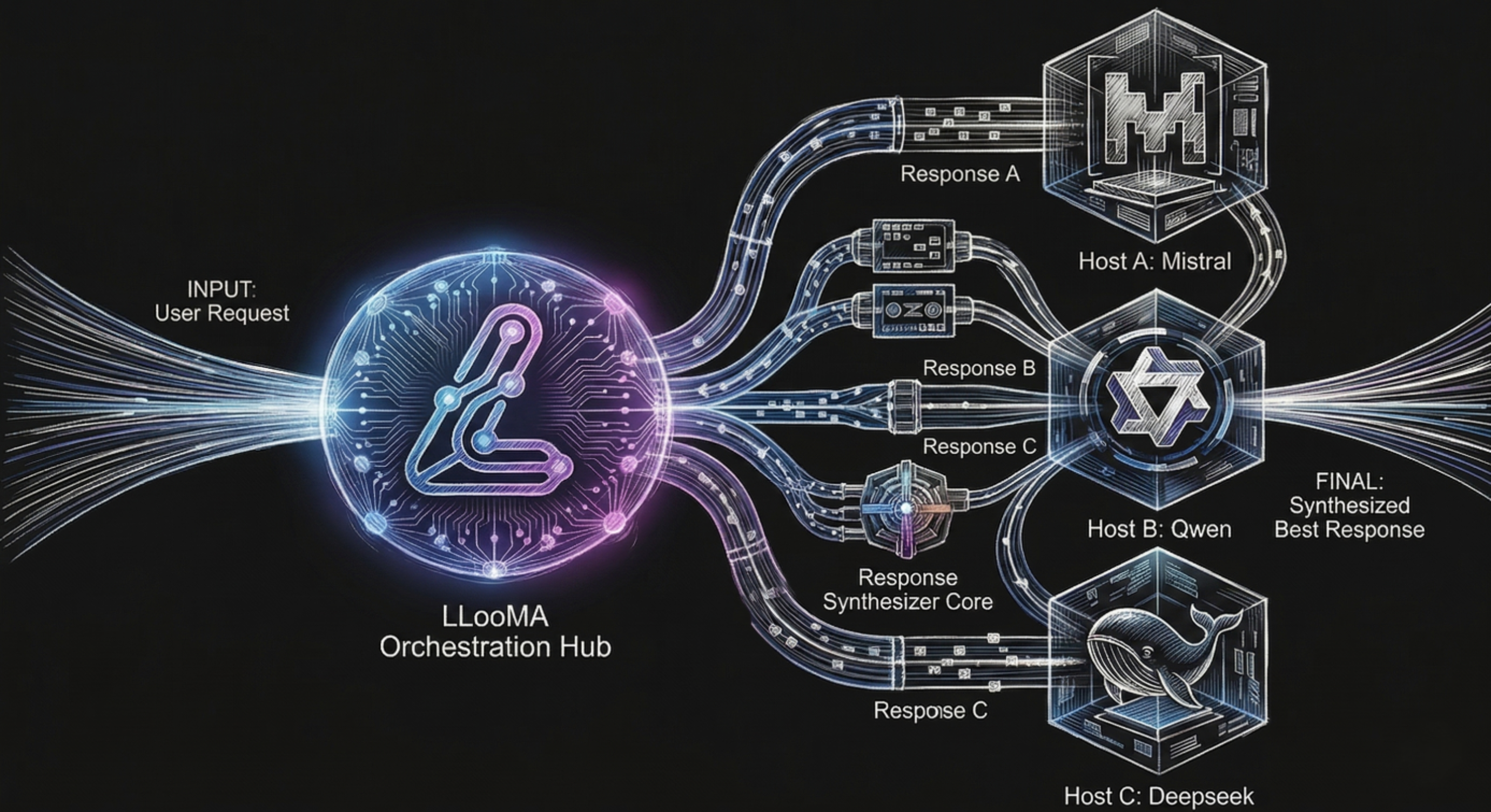
<p>~ Hassan Habib</p>]]></content><author><name>Hassan Habib</name></author><category term="releases" /><category term="peerllm" /><category term="release-notes" /><category term="announcement" /><summary type="html"><![CDATA[v1.6.0 is our biggest release yet — run multiple models at once, chat in parallel without cross-talk, and redeem token codes right from the hosts portal.]]></summary></entry><entry><title type="html">PeerLLM v1.5.0 - Introducing LLooMA, The Network-Native Mind</title><link href="https://peerllm.github.io/peerllm/release%20notes/2026/04/11/llooma-announcement-with-v1.5.0.html" rel="alternate" type="text/html" title="PeerLLM v1.5.0 - Introducing LLooMA, The Network-Native Mind" /><published>2026-04-11T00:00:00+00:00</published><updated>2026-04-11T00:00:00+00:00</updated><id>https://peerllm.github.io/peerllm/release%20notes/2026/04/11/llooma-announcement-with-v1.5.0</id><content type="html" xml:base="https://peerllm.github.io/peerllm/release%20notes/2026/04/11/llooma-announcement-with-v1.5.0.html"><![CDATA[<p>PeerLLM v1.5.0 is a major step forward.</p>

<p>This release is not just about improvements.<br />
It introduces a new way of thinking about intelligence in distributed systems.</p>

<hr />

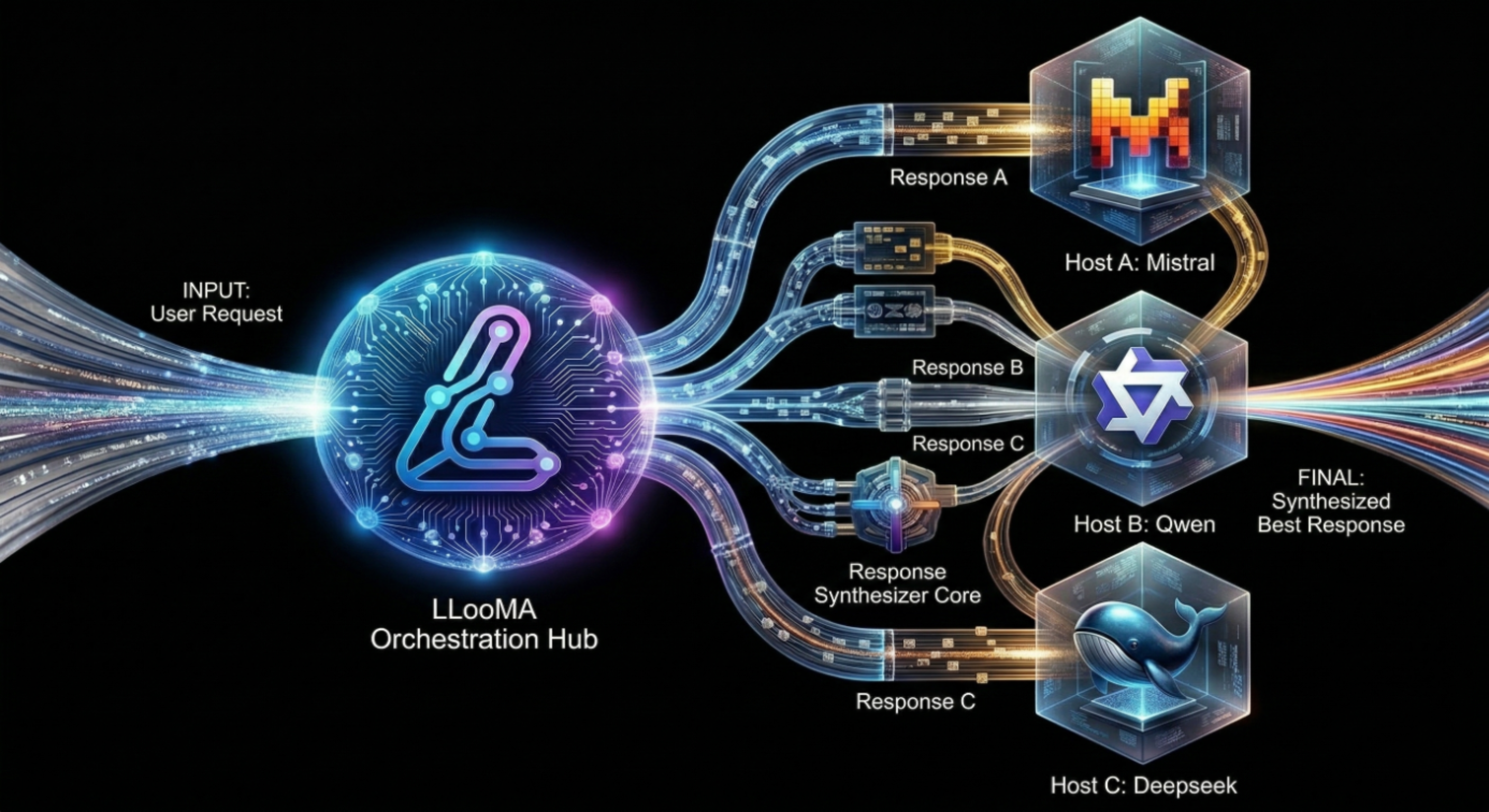
<h2 id="0-llooma-v10---the-llm-of-all-llms">0/ LLooMA v1.0 - The LLM of All LLMs</h2>

<p>LLooMA v1.0 is here.</p>

<p>It is not a single model.</p>

<blockquote>
  <p><strong>It is the orchestration of all models across the network.</strong></p>
</blockquote>

<p>LLooMA takes your prompt and:</p>
<ul>
  <li>Analyzes it</li>
  <li>Reformats it</li>
  <li>Optimizes it</li>
  <li>Routes it to one or many hosts based on expertise and complexity</li>
</ul>

<div class="post-image">
  <img src="/assets/images/llooma-overview.png" alt="New UI experience" />
</div>

<p>This is where PeerLLM becomes something fundamentally different.</p>

<p>LLooMA does not just execute.<br />
It <strong>thinks about execution</strong>.</p>

<hr />

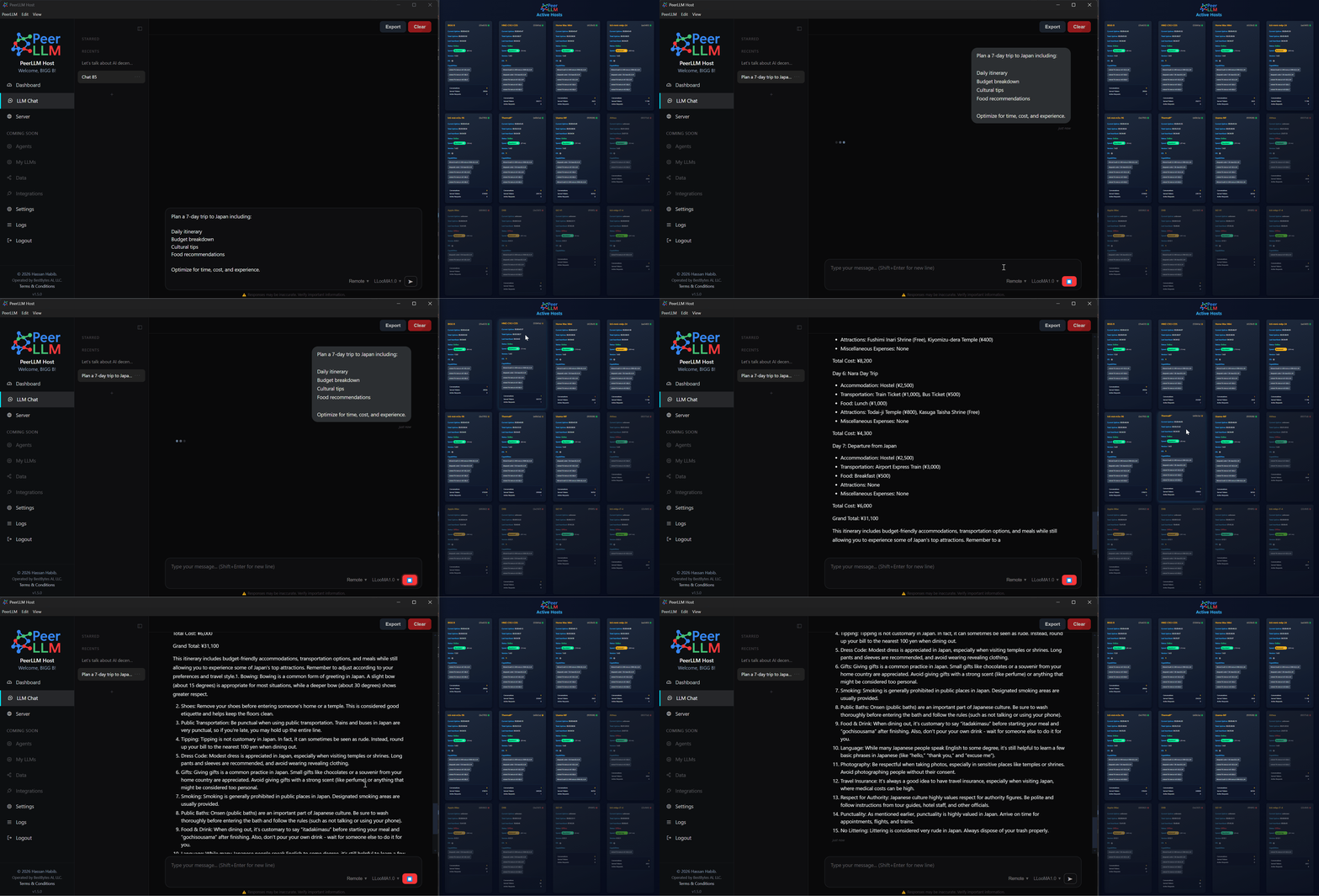
<h2 id="1-real-time-intervention--resilience">1/ Real-Time Intervention &amp; Resilience</h2>

<p>LLooMA actively monitors execution across the network.</p>

<ul>
  <li>If a host is too slow -&gt; LLooMA intervenes</li>
  <li>If a host stalls -&gt; LLooMA reroutes</li>
  <li>If local inference fails -&gt; LLooMA fills the gap</li>
</ul>

<p>This creates a system that is not just distributed, but <strong>adaptive in real time</strong>.</p>

<div class="post-image">
  <img src="/assets/images/v1.5.0-llooma-demo.gif" alt="New UI experience" />
</div>

<hr />

<h2 id="2-a-new-dimension-of-scaling">2/ A New Dimension of Scaling</h2>

<p>Traditional systems scale:</p>
<ul>
  <li>Vertically (bigger machines)</li>
  <li>Horizontally (more machines)</li>
</ul>

<p>LLooMA introduces a third dimension:</p>

<blockquote>
  <p><strong>Intelligent scaling, conceptual, logical, and real time.</strong></p>
</blockquote>

<p>The system adapts based on the nature of the prompt itself.</p>

<p>This is only possible because of the decentralized architecture of PeerLLM.</p>

<hr />

<h2 id="3-beyond-the-cloud-toward-community-intelligence">3/ Beyond the Cloud Toward Community Intelligence</h2>

<p>Cloud infrastructure gave us availability zones.</p>

<p>PeerLLM pushes this further.</p>

<blockquote>
  <p><strong>The vision is simple: your availability zone becomes your community.</strong></p>
</blockquote>

<ul>
  <li>Your neighbor’s machine can serve inference</li>
  <li>Your tokens contribute to real people</li>
  <li>Intelligence becomes a shared local economy</li>
</ul>

<p>This is geo-redundancy at a level traditional data centers cannot reach.</p>

<p>And this is just the beginning.</p>

<hr />

<h2 id="4-accessing-llooma">4/ Accessing LLooMA</h2>

<p>LLooMA is available today:</p>

<ul>
  <li>Through PeerLLM RESTful APIs</li>
  <li>Directly from your Host software</li>
</ul>

<p>Same interface.<br />
Completely new capability.</p>

<hr />

<h2 id="5-peerllm-host-v150---a-new-experience">5/ PeerLLM Host v1.5.0 - A New Experience</h2>

<p>The Host software has been significantly upgraded.</p>

<h3 id="50-modern-chat-uiux">5.0/ Modern Chat UI/UX</h3>
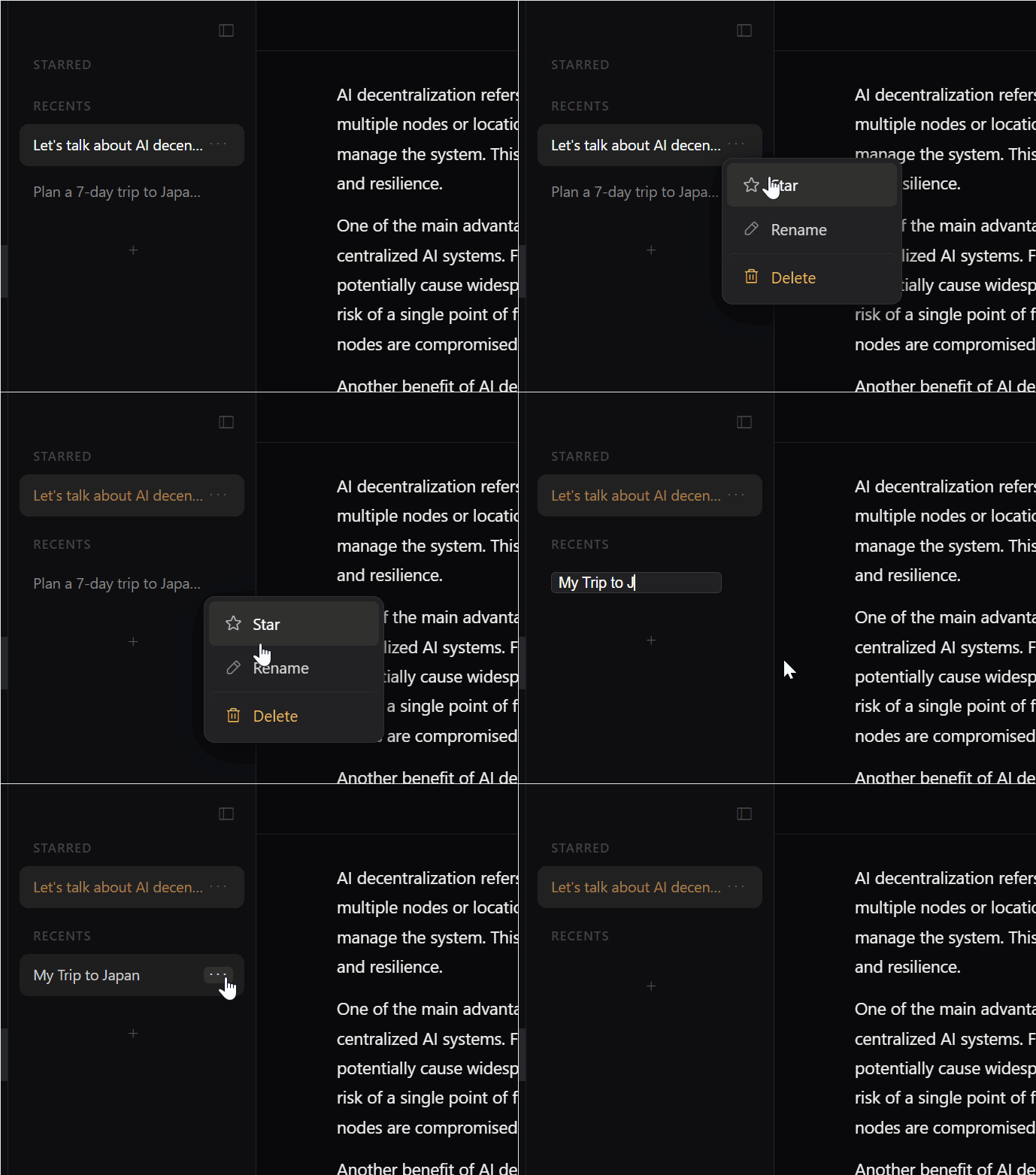
<ul>
  <li>Cleaner, more intuitive interface</li>
  <li>Left-side chat navigation</li>
  <li>Rename and favorite conversations</li>
</ul>

<div class="post-image">
  <img src="/assets/images/v1.5.0-chat-menu-options.gif" alt="New UI experience" />
</div>

<h3 id="51-mode-control">5.1/ Mode Control</h3>
<ul>
  <li>Switch between <strong>Local</strong>, <strong>Network</strong>, and <strong>Remote</strong> modes</li>
  <li>Dynamically view and select available models per mode</li>
</ul>

<p>Everything is faster, clearer, and easier to use.</p>

<div class="post-image">
  <img src="/assets/images/v1.5.0-chat-new-ui-ux.png" alt="New UI experience" />
</div>

<hr />

<h2 id="6-expanding-beyond-text">6/ Expanding Beyond Text</h2>

<p>The chat experience is evolving.</p>

<p>Soon you will be able to:</p>
<ul>
  <li>Generate images</li>
  <li>Work with audio</li>
  <li>Produce video</li>
</ul>

<p>LLooMA makes this evolution possible.</p>

<hr />

<h2 id="7-more-control-for-an-agentic-future">7/ More Control for an Agentic Future</h2>

<p>We’ve expanded orchestration capabilities across the system:</p>

<ul>
  <li>Temperature control</li>
  <li>Max token configuration</li>
  <li>Enhanced messaging flow</li>
</ul>

<p>These changes move PeerLLM closer to an <strong>agent-driven future</strong>, where software can reason, decide, and act more effectively.</p>

<hr />

<h2 id="8-additional-improvements">8/ Additional Improvements</h2>

<ul>
  <li>Last-used models now appear at the top</li>
  <li>Temporary load status indicators for remote requests</li>
  <li>Performance and stability improvements across the board</li>
</ul>

<hr />

<h2 id="closing">Closing</h2>

<p>PeerLLM is evolving into something much bigger than a network of hosts.</p>

<p>It is becoming a <strong>living system of intelligence</strong>.</p>

<p>A system where:</p>
<ul>
  <li>Intelligence is shared</li>
  <li>Value stays with people</li>
  <li>And computation becomes a community effort</li>
</ul>

<p>To everyone joining the network early and helping power this vision:</p>

<blockquote>
  <p><strong>Thank you. You are the reason this exists.</strong></p>
</blockquote>

<hr />

<p><strong>Hassan</strong></p>]]></content><author><name></name></author><category term="PeerLLM" /><category term="Release Notes" /><summary type="html"><![CDATA[PeerLLM v1.5.0 is a major step forward.]]></summary></entry><entry><title type="html">LLooMA In Depth - A Network-Native Orchestration Architecture</title><link href="https://peerllm.github.io/peerllm/architecture/llooma/2026/04/11/llooma-in-depth.html" rel="alternate" type="text/html" title="LLooMA In Depth - A Network-Native Orchestration Architecture" /><published>2026-04-11T00:00:00+00:00</published><updated>2026-04-11T00:00:00+00:00</updated><id>https://peerllm.github.io/peerllm/architecture/llooma/2026/04/11/llooma-in-depth</id><content type="html" xml:base="https://peerllm.github.io/peerllm/architecture/llooma/2026/04/11/llooma-in-depth.html"><![CDATA[<p>LLooMA 1.0 (Low-Latency Orchestration of Models and Agents) is a network-native orchestration system that operates at a layer above traditional large language models. Unlike conventional models, LLooMA does not exist as a set of weights or a runtime artifact. It is not deployed on any host machine, nor is it executed as a standalone inference engine. Instead, LLooMA exists entirely within the PeerLLM orchestrator as a decision-making system responsible for coordinating how intelligence is applied across a decentralized network of independently operated hosts.</p>

<div class="post-image">
  <img src="/assets/images/llooma-v1.0-vision.png" alt="New UI experience" />
</div>

<p>At its core, LLooMA transforms a single prompt into a distributed execution plan. Rather than treating a request as a monolithic unit of work, the system evaluates whether the request can benefit from decomposition, parallelism, or staged execution. This allows LLooMA to dynamically adapt its strategy based on the complexity and structure of the incoming request, providing a level of flexibility and efficiency that is not achievable through single-model inference.</p>

<hr />

<h2 id="0-architectural-positioning">0/ Architectural Positioning</h2>

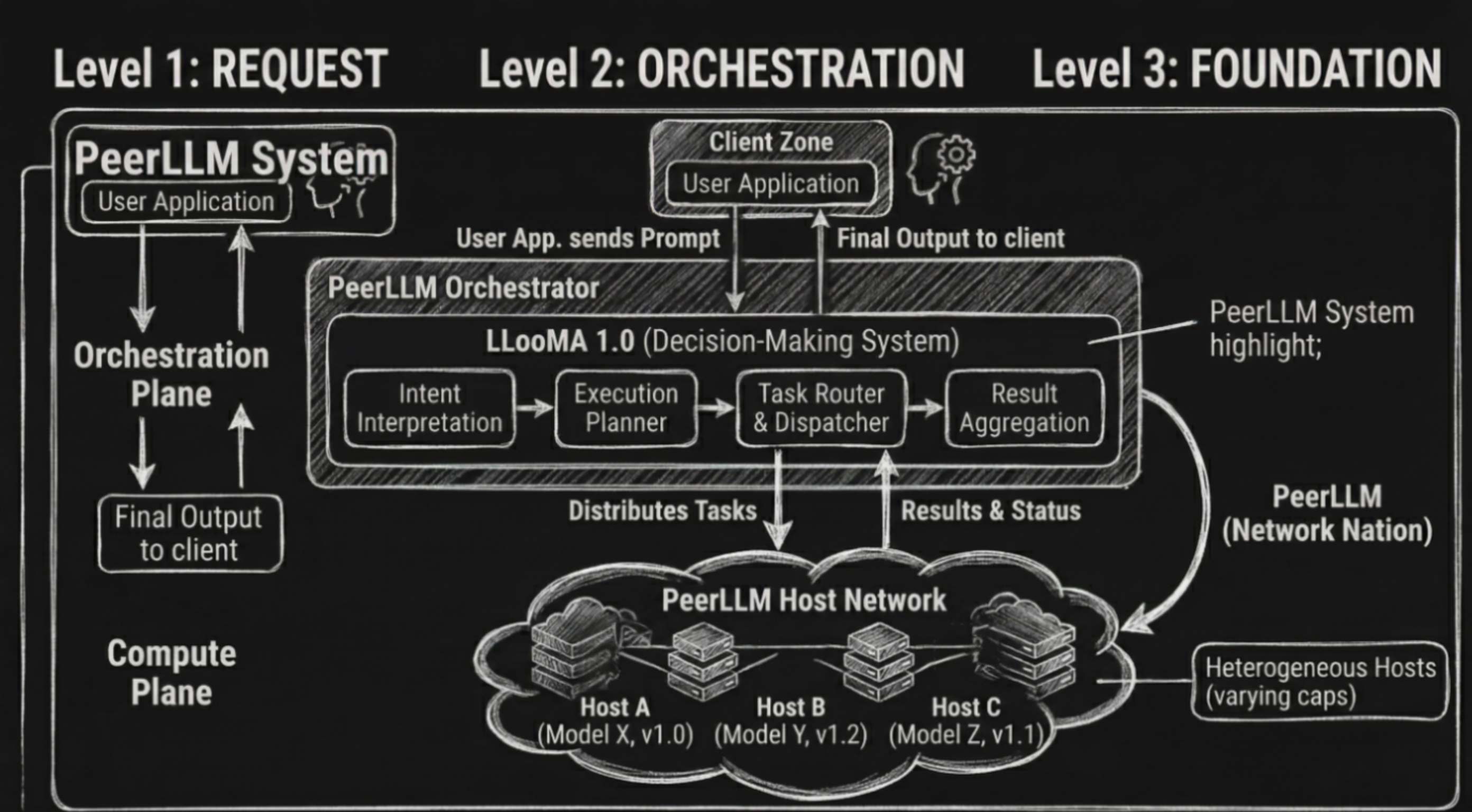
<p>From an architectural perspective, LLooMA occupies a unique position between traditional inference systems and distributed execution frameworks. It combines characteristics of both, while introducing a new abstraction layer that focuses on orchestration rather than computation.</p>

<div class="post-image">
  <img src="/assets/images/llooma-v1.0-high-level.png" alt="New UI experience" />
</div>

<p>The PeerLLM network provides the compute layer, consisting of heterogeneous hosts running local models with varying capabilities, performance characteristics, and availability. LLooMA operates as the control plane for this network. It is responsible for interpreting user intent, constructing execution plans, routing tasks, enforcing latency constraints, and aggregating results into a coherent output. This separation of concerns allows the system to scale compute independently from decision-making logic, enabling more sophisticated orchestration strategies over time.</p>

<hr />

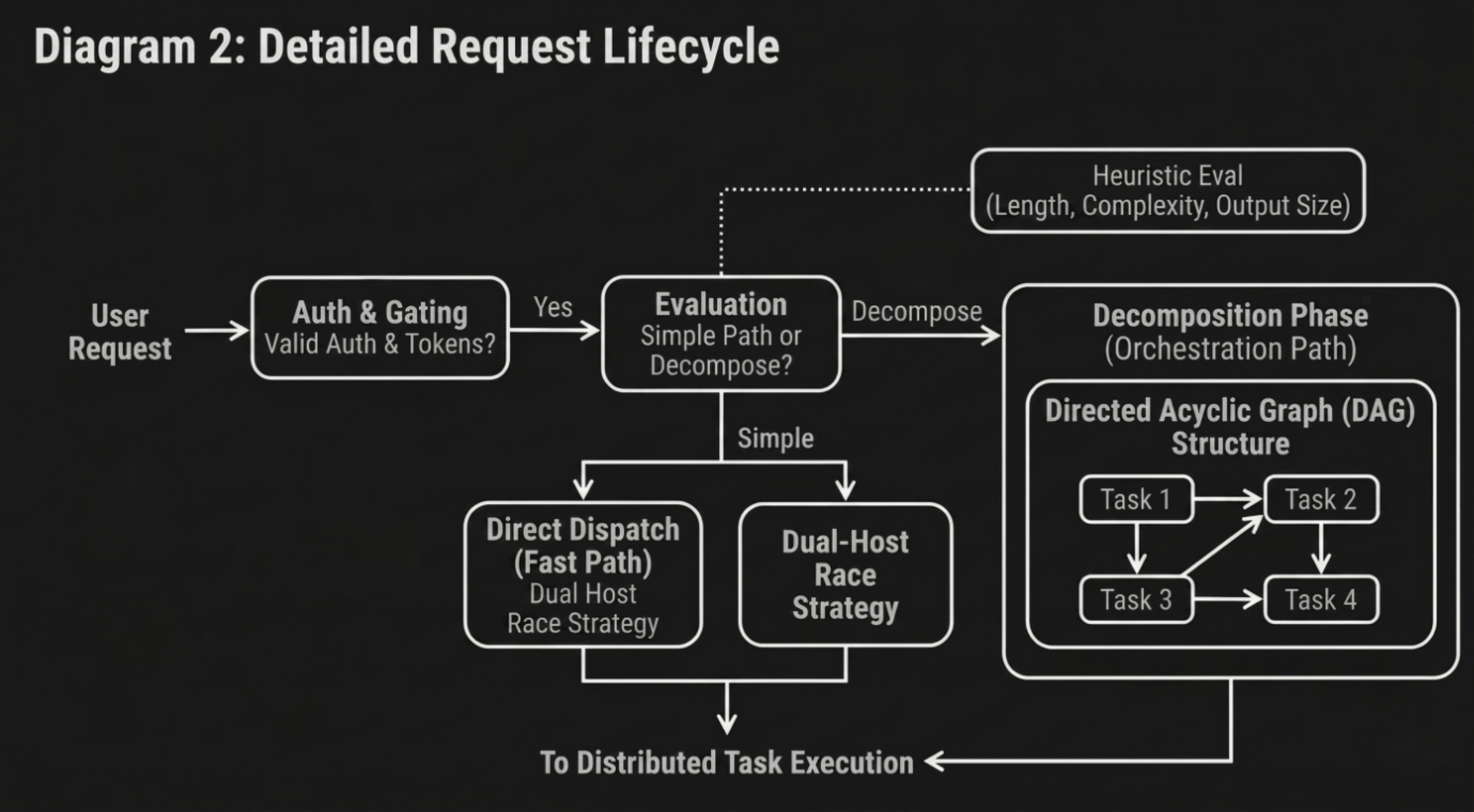
<h2 id="1-request-lifecycle-and-execution-model">1/ Request Lifecycle and Execution Model</h2>

<p>Every request entering the system follows a structured lifecycle. The orchestrator first validates authentication and ensures sufficient token balance before any compute resources are allocated. This early gating mechanism prevents unnecessary load on the network and guarantees that all subsequent work is economically valid.</p>

<div class="post-image">
  <img src="/assets/images/llooma-v1.0-request-lifecycle.png" alt="New UI experience" />
</div>

<p>Once validated, LLooMA inspects the request to determine whether it should be processed as a single unit or decomposed into multiple tasks. This decision is based on heuristic evaluation of prompt length, structural complexity, and expected output size. Simple requests are routed through a fast path that bypasses orchestration and directly leverages the network through a dual-host race strategy. More complex requests proceed to the decomposition phase.</p>

<p>In the decomposition phase, the request is transformed into a directed acyclic graph (DAG) of tasks. Each node in the graph represents a self-contained unit of work, defined by its own prompt, dependencies, and execution constraints. The DAG structure allows LLooMA to identify parallelizable segments of the problem while preserving necessary execution order for dependent tasks. This model enables efficient utilization of network resources by executing independent tasks concurrently while coordinating dependent tasks in sequence.</p>

<hr />

<h2 id="2-distributed-task-execution">2/ Distributed Task Execution</h2>

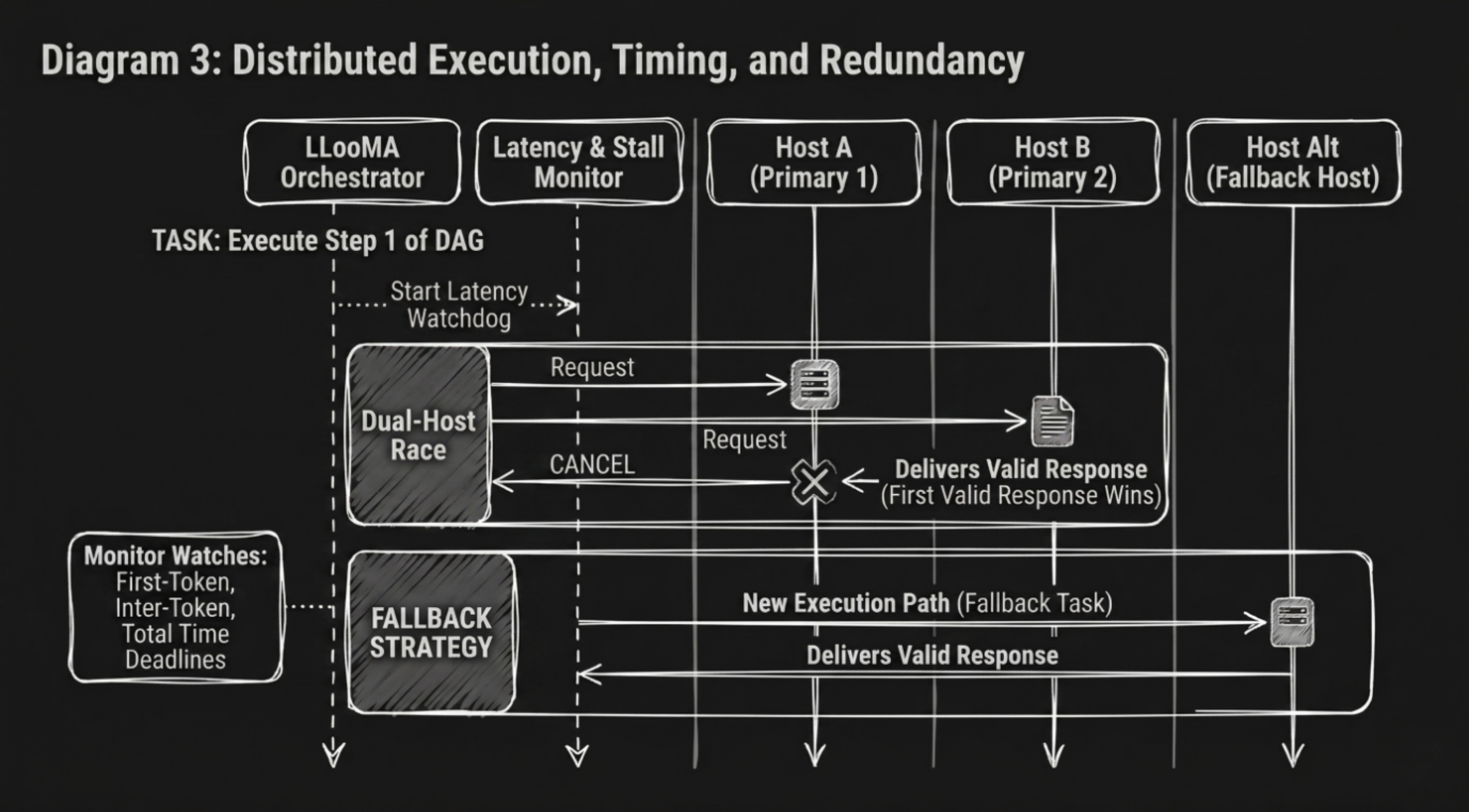
<p>Task execution is performed across the PeerLLM host network. For each task, LLooMA selects eligible hosts based on liveness, capability, software version, and historical performance metrics. Rather than assigning a task to a single host, the system initiates a dual-host race. Multiple hosts receive the same task concurrently, and the first host to produce a valid response is selected as the winner. All other participating hosts are immediately cancelled.</p>

<p>Every request entering the system follows a structured lifecycle. The orchestrator first validates authentication and ensures sufficient token balance before any compute resources are allocated. This early gating mechanism prevents unnecessary load on the network and guarantees that all subsequent work is economically valid.</p>

<div class="post-image">
  <img src="/assets/images/llooma-v1.0-sequential-diagram.png" alt="New UI experience" />
</div>

<p>This race-based execution model significantly reduces latency and mitigates the impact of slow or unreliable hosts. It also introduces a natural form of redundancy without requiring explicit replication strategies. By favoring the fastest valid response, LLooMA ensures that the system consistently delivers low-latency results even in the presence of heterogeneous infrastructure.</p>

<hr />

<h2 id="3-latency-enforcement-and-failure-handling">3/ Latency Enforcement and Failure Handling</h2>

<p>A key aspect of LLooMA’s architecture is its strict enforcement of latency budgets. Each task execution is governed by multiple timing constraints, including first-token deadlines, inter-token stall detection, and total response time limits. These constraints are continuously monitored throughout execution.</p>

<p>If a host fails to produce an initial response within the allowed time window, the system abandons the host and initiates a fallback strategy. Similarly, if a response stalls during streaming, LLooMA intervenes and continues the generation process through an alternative execution path. This ensures that no single host can degrade the user experience by introducing excessive latency or incomplete outputs.</p>

<p>Failure handling is designed to be seamless. Partial outputs are preserved and extended when possible, allowing the system to recover gracefully without restarting the entire computation. This approach minimizes wasted work and maintains continuity in the generated response.</p>

<div class="post-image" style="text-align: center;">
  <iframe width="800" height="450" src="https://www.youtube.com/embed/OJ7dzkl-Sck?si=JIhcEgcUYerfzaKI" title="YouTube video player" frameborder="0" allow="accelerometer; autoplay; clipboard-write; encrypted-media; gyroscope; picture-in-picture; web-share" referrerpolicy="strict-origin-when-cross-origin" allowfullscreen=""></iframe>
</div>
<hr />

<h2 id="4-response-normalization-and-context-management">4/ Response Normalization and Context Management</h2>

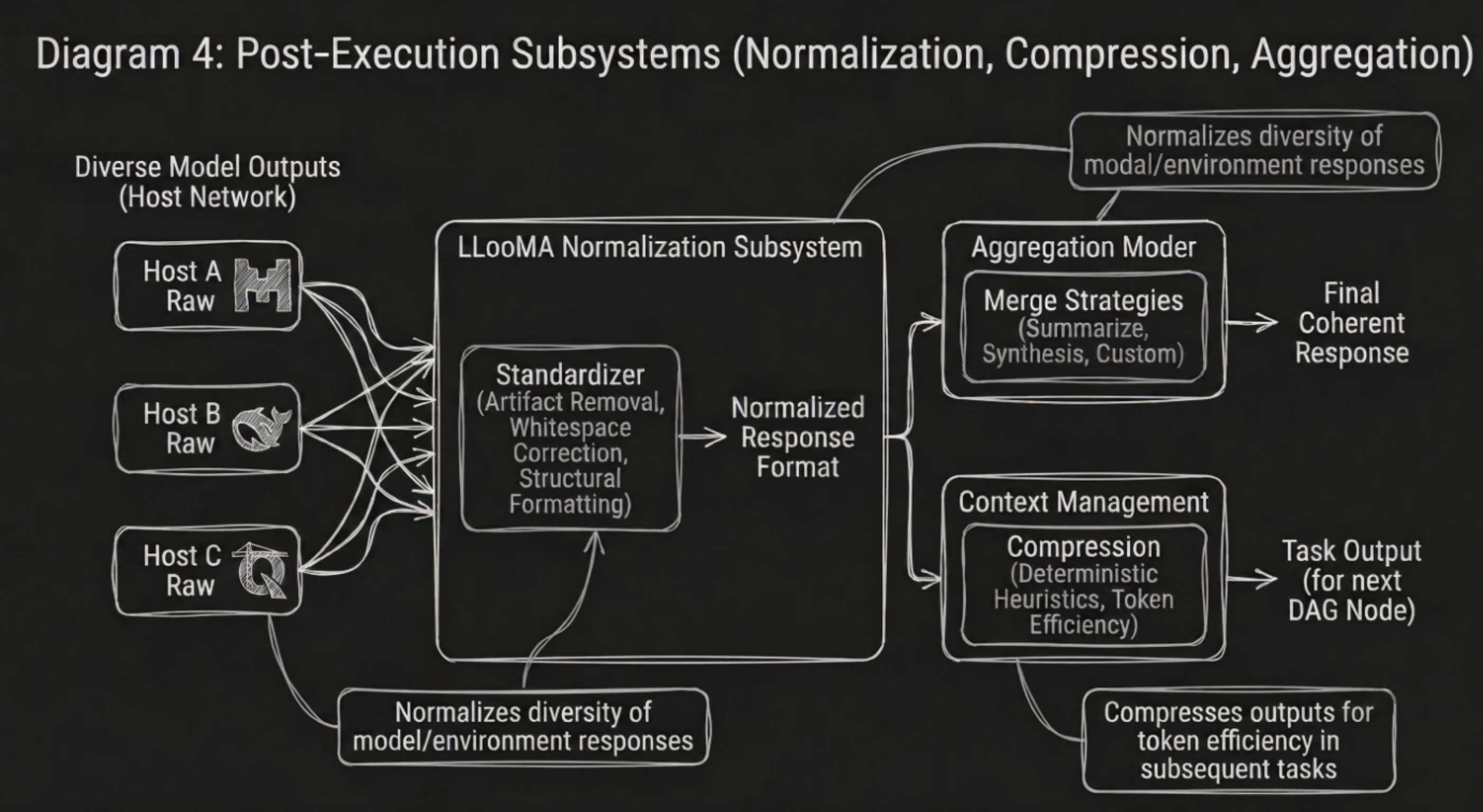
<p>Given the diversity of models and environments within the network, responses can vary significantly in format and structure. LLooMA addresses this through a dedicated normalization layer that standardizes outputs before they are consumed by downstream tasks or returned to the client.</p>

<p>Normalization includes the removal of model-specific artifacts, whitespace correction, and structural formatting adjustments. This ensures that all outputs conform to a consistent representation, regardless of their source.</p>

<p>In addition to normalization, LLooMA implements context compression to manage token efficiency. When task outputs are used as inputs for subsequent tasks, they are compressed using deterministic heuristics that preserve essential information while reducing token count. This allows the system to maintain high throughput without incurring excessive token costs.</p>

<hr />

<h2 id="5-result-aggregation">5/ Result Aggregation</h2>

<p>Once all tasks in the DAG have completed, LLooMA aggregates their outputs into a final response. The aggregation process is guided by task-level merge strategies, which define how individual results should be combined. These strategies include simple concatenation, replacement, summarization, and custom synthesis.</p>

<div class="post-image">
  <img src="/assets/images/llooma-v1.0-subsystems.png" alt="New UI experience" />
</div>

<p>Aggregation may be performed mechanically or through an additional intelligence layer, depending on the complexity of the task graph. The objective is to produce a single coherent response that abstracts away the underlying distributed execution. From the client’s perspective, the result appears as if it were generated by a single system, despite being the product of multiple coordinated computations.</p>

<hr />

<h2 id="6-scaling-characteristics">6/ Scaling Characteristics</h2>

<p>Traditional systems scale along two primary dimensions: vertical scaling, which increases the capacity of individual machines, and horizontal scaling, which increases the number of machines. LLooMA introduces a third dimension: intelligent scaling.</p>

<p>Intelligent scaling refers to the system’s ability to adapt its execution strategy based on the nature of the request. Simple requests incur minimal overhead and are processed directly, while complex requests trigger distributed execution across multiple hosts. This dynamic adjustment allows the system to allocate resources efficiently, scaling computational effort in proportion to problem complexity rather than uniformly across all requests.</p>

<hr />

<h2 id="7-reliability-in-a-decentralized-environment">7/ Reliability in a Decentralized Environment</h2>

<p>Decentralized networks are inherently unpredictable. Hosts may join or leave at any time, performance characteristics may vary, and network conditions may fluctuate. LLooMA is designed to operate effectively within this environment by assuming that failure is the norm rather than the exception.</p>

<p>The combination of host racing, latency enforcement, fallback strategies, and continuous monitoring creates a resilient system that maintains consistent performance despite underlying instability. By decoupling execution from any single host and continuously adapting to network conditions, LLooMA achieves a level of reliability that would be difficult to attain in a purely centralized or purely decentralized system.</p>

<hr />

<h2 id="8-conclusion">8/ Conclusion</h2>

<p>LLooMA represents a shift in how intelligence systems are designed and deployed. Rather than focusing on improving individual models, it introduces an orchestration layer that determines how multiple models and machines collaborate to solve a problem.</p>

<p>This approach enables a more flexible, scalable, and resilient system, where intelligence is not confined to a single model but distributed across a network. As the PeerLLM network grows, LLooMA’s ability to coordinate and optimize execution will continue to improve, further enhancing the capabilities of the system.</p>

<p>In this architecture, intelligence is no longer a static artifact. It becomes a dynamic process, shaped by the interaction between decision-making logic and distributed compute resources.</p>

<p><br /></p>

<p>👉 <strong>Download the full whitepaper:</strong><br />
<a href="/assets/files/llooma-whitepaper-v1.0.0.pdf">LLooMA Whitepaper v1.0.0 (PDF)</a></p>

<hr />

<p><strong>Hassan</strong></p>]]></content><author><name></name></author><category term="PeerLLM" /><category term="Architecture" /><category term="LLooMA" /><summary type="html"><![CDATA[LLooMA 1.0 (Low-Latency Orchestration of Models and Agents) is a network-native orchestration system that operates at a layer above traditional large language models. Unlike conventional models, LLooMA does not exist as a set of weights or a runtime artifact. It is not deployed on any host machine, nor is it executed as a standalone inference engine. Instead, LLooMA exists entirely within the PeerLLM orchestrator as a decision-making system responsible for coordinating how intelligence is applied across a decentralized network of independently operated hosts.]]></summary></entry><entry><title type="html">PeerLLM v1.4.0 - Faster Hosts, Smarter Control, Real Momentum</title><link href="https://peerllm.github.io/peerllm/release%20notes/2026/04/06/v1.4.0-release.html" rel="alternate" type="text/html" title="PeerLLM v1.4.0 - Faster Hosts, Smarter Control, Real Momentum" /><published>2026-04-06T00:00:00+00:00</published><updated>2026-04-06T00:00:00+00:00</updated><id>https://peerllm.github.io/peerllm/release%20notes/2026/04/06/v1.4.0-release</id><content type="html" xml:base="https://peerllm.github.io/peerllm/release%20notes/2026/04/06/v1.4.0-release.html"><![CDATA[<h1 id="peerllm-v140---faster-hosts-smarter-control-real-momentum">PeerLLM v1.4.0 - Faster Hosts, Smarter Control, Real Momentum</h1>

<p>PeerLLM v1.4.0 is about one thing.</p>

<blockquote>
  <p><strong>Giving Hosts more control over performance, availability, and their machine.</strong></p>
</blockquote>

<p>This release focuses on real-world behavior.</p>

<ul>
  <li>Faster responses</li>
  <li>Better memory management</li>
  <li>More predictable host control</li>
</ul>

<p>Most importantly, it respects the Host’s environment.</p>

<hr />

<h2 id="0-pre-loaded-models-faster-response-times">0/ Pre-Loaded Models (Faster Response Times)</h2>

<p>One of the biggest challenges in decentralized inference is latency at startup.</p>

<p>Previously, a request would arrive, the model would load into memory, then the request would be served.</p>

<p>Depending on the system, this could take time. Sometimes a lot of time.</p>

<h3 id="now">Now</h3>

<p>Hosts can manually pre-load LLMs into memory.</p>

<ul>
  <li>Models stay ready to serve immediately</li>
  <li>No cold-start delays</li>
  <li>Faster response times</li>
</ul>

<p>This only happens when you explicitly choose to pre-load a model.</p>

<div class="post-image">
  <img src="/assets/images/v1.4.0-pre-load-llms.gif" alt="Preloading Models" />
</div>

<hr />

<h3 id="smart-fallback-still-applies">Smart Fallback Still Applies</h3>

<p>If a model is not pre-loaded, it will still load on demand.</p>

<p>The network sends the task to multiple hosts and selects the fastest response available.</p>

<blockquote>
  <p>Even without preloading, the network remains fast and resilient.</p>
</blockquote>

<hr />

<h2 id="1-smarter-memory-management-vram-protection">1/ Smarter Memory Management (VRAM Protection)</h2>

<p>Running out of VRAM is real. Especially when testing multiple models.</p>

<p>PeerLLM now automatically unloads models when needed.</p>

<p>This happens when:</p>
<ul>
  <li>A new request requires a different model</li>
  <li>Memory capacity is exceeded</li>
</ul>

<p>This means:</p>

<ul>
  <li>No manual cleanup</li>
  <li>No silent failures</li>
  <li>The system adapts in real time</li>
</ul>

<hr />

<h2 id="2-improved-uiux-for-model-awareness">2/ Improved UI/UX for Model Awareness</h2>

<p>You can now clearly see what is happening inside your machine.</p>

<ul>
  <li>Which models are loaded</li>
  <li>Which models were manually pre-loaded</li>
  <li>A clearer view of your LLM inventory</li>
</ul>

<p>You can also unload models manually.</p>

<p>If there are active sessions, you will see a warning.</p>

<p>⚠️ Important guidance</p>

<blockquote>
  <p>Avoid unloading a model while there are active remote sessions.</p>
</blockquote>

<p>Doing so interrupts users and may signal instability from your host.</p>

<hr />

<div class="post-image">
  <img src="/assets/images/v1.4.0-unloading-llm-while-in-session.png" alt="Unloading a model while in a remote session." />
</div>

<hr />

<h2 id="3-scheduled-host-availability-previously-released-now-official">3/ Scheduled Host Availability (Previously Released, Now Official)</h2>

<p>This feature was introduced in v1.0.0 but not announced.</p>

<p>Now it is official.</p>

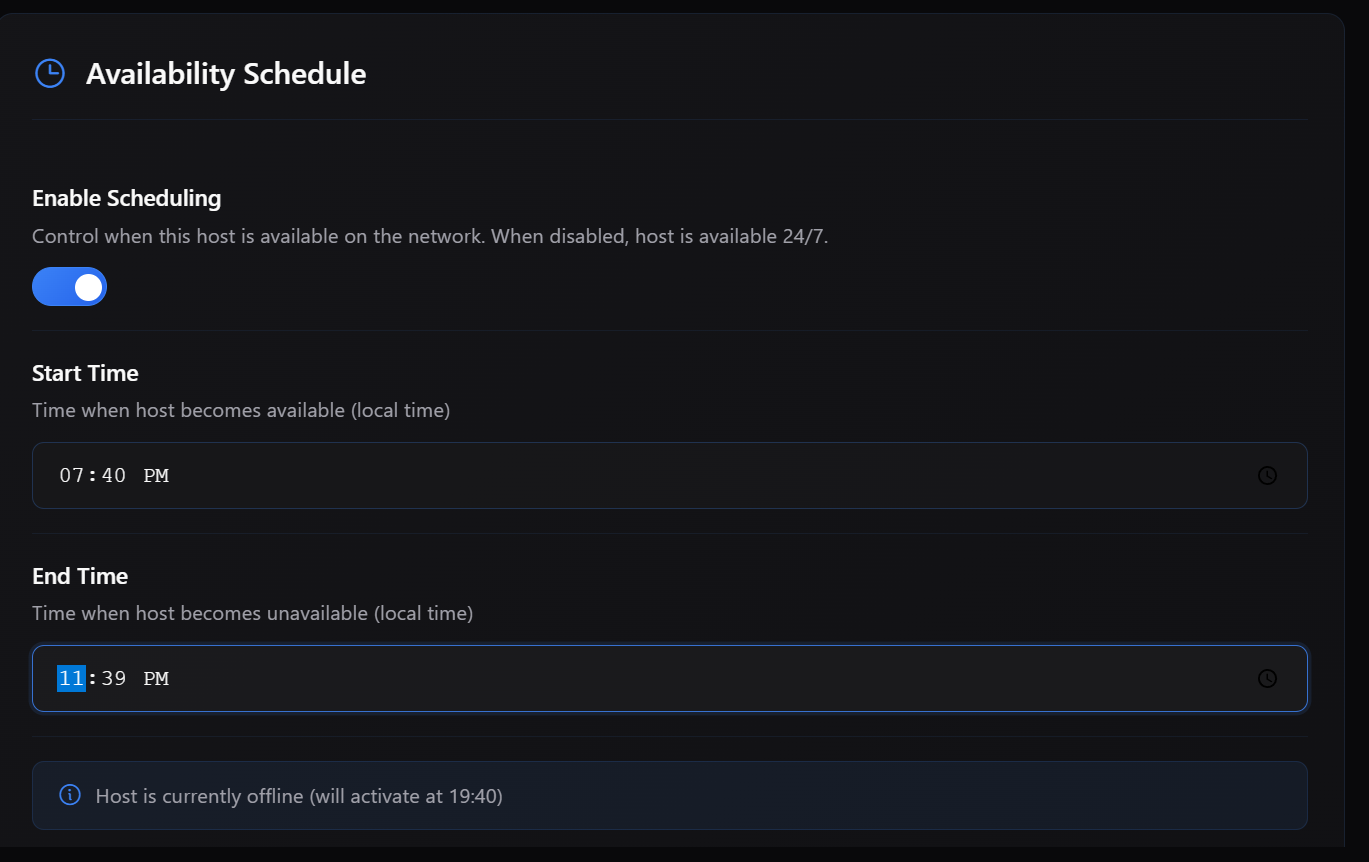
<p>You can schedule when your host is online.</p>

<p>You can also automatically go offline during busy hours.</p>

<p>This is useful for shared machines, night-time usage, and predictable availability.</p>

<div class="post-image">
  <img src="/assets/images/v1.4.0-schedule-working-hours.png" alt="Scheduled working hours" />
</div>

<hr />

<h2 id="4-manual-offline-mode">4/ Manual Offline Mode</h2>

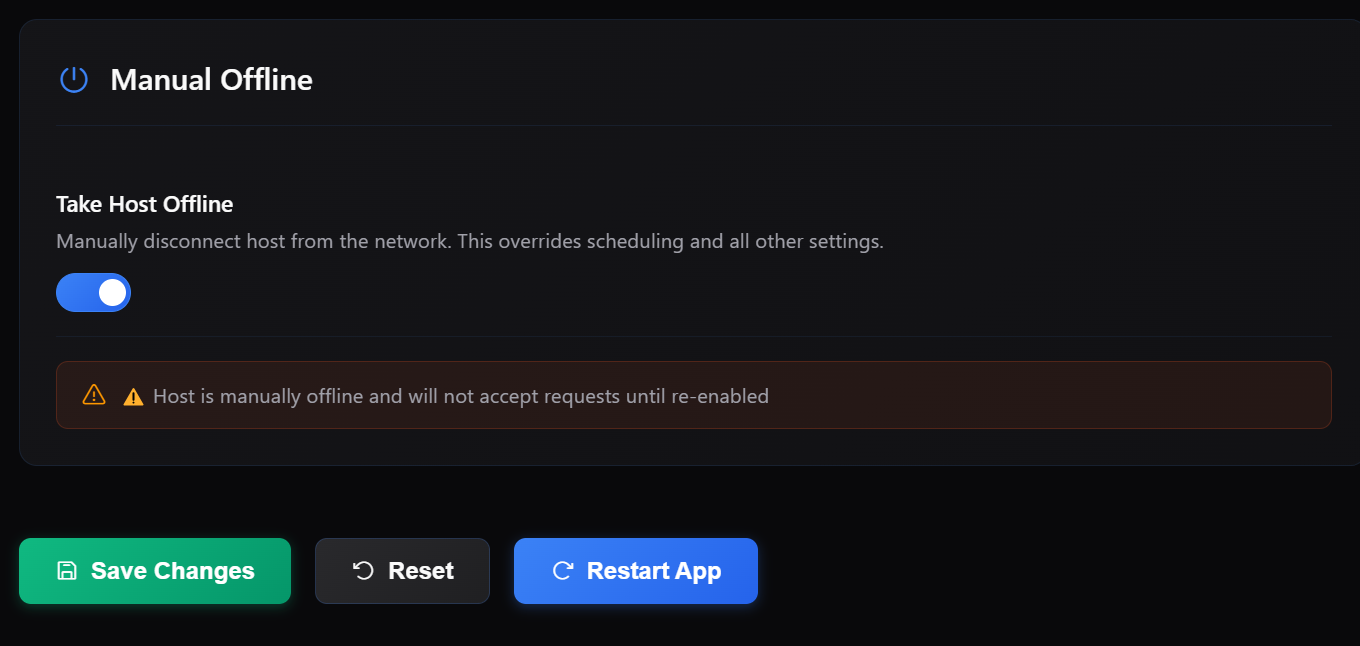
<p>You now have full control to go offline instantly.</p>

<ul>
  <li>Stop receiving network traffic</li>
  <li>Continue using your machine locally</li>
</ul>

<p>The host will remain offline until you bring it back online.</p>

<div class="post-image">
  <img src="/assets/images/v1.4.0-manual-host-offline.png" alt="Manual offline mode" />
</div>

<hr />

<h2 id="5-system-tray-support-run-quietly">5/ System Tray Support (Run Quietly)</h2>

<p>This is one of the most practical upgrades.</p>

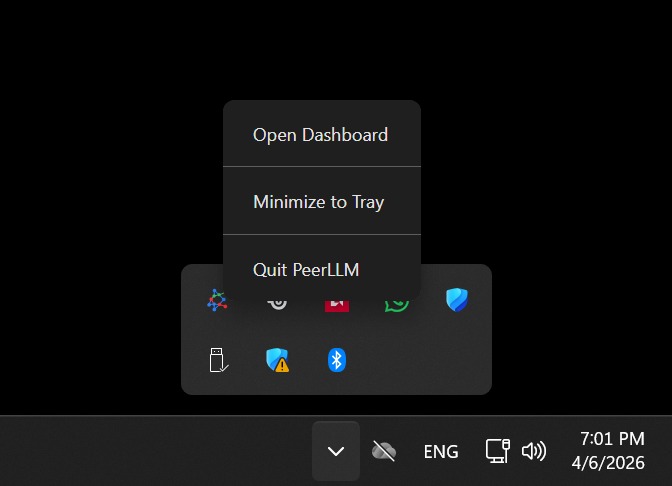
<p>You can now minimize PeerLLM to the system tray.</p>

<ul>
  <li>Keep it running without UI clutter</li>
  <li>Reopen or exit from a simple context menu</li>
</ul>

<p>PeerLLM becomes:</p>

<blockquote>
  <p>Part of your system. Not something in your way.</p>
</blockquote>

<div class="post-image">
  <img src="/assets/images/v1.4.0-system-tray-enabled.jpeg" alt="System tray support" />
</div>

<hr />

<h2 id="6-the-bigger-picture">6/ The Bigger Picture</h2>

<p>PeerLLM is not just a tool.</p>

<p>It is a network of individuals contributing intelligence.</p>

<p>Right now:</p>

<ul>
  <li>The network is live</li>
  <li>Hosts are generating small amounts of revenue</li>
  <li>This comes from compliance and validation traffic</li>
</ul>

<p>We are now entering the next phase.</p>

<p>Payouts are being tested once hosts reach $25.</p>

<p>This is an important milestone for the network.</p>

<p>I want to say this clearly.</p>

<p>I am deeply grateful for those of you who are already running as Hosts.</p>

<p>Especially those subscribing at this early stage.</p>

<p>You are not just users of the system.<br />
You are builders of a global decentralized intelligence.</p>

<blockquote>
  <p>You are one of the reasons I keep pushing forward with this project.</p>
</blockquote>

<hr />

<h2 id="7-whats-coming-next">7/ What’s Coming Next</h2>

<p>I am actively working with local and national businesses.</p>

<p>The goal is to integrate PeerLLM into real-world systems.</p>

<blockquote>
  <p>I expect this upcoming quarter to introduce paid business usage into the network.</p>
</blockquote>

<p>This means:</p>

<ul>
  <li>More traffic</li>
  <li>More value</li>
  <li>More opportunity for Hosts</li>
</ul>

<hr />

<h2 id="final-thought">Final Thought</h2>

<p>Every release of PeerLLM is a step toward something bigger.</p>

<blockquote>
  <p>A world where intelligence is not owned, but contributed, shared, and rewarded.</p>
</blockquote>

<p>And it starts with you. The Host.</p>

<hr />

<p>Stay online.<br />
Or don’t. Now you get to choose.</p>

<p>~ Hassan <br />
2026-04-06</p>]]></content><author><name></name></author><category term="PeerLLM" /><category term="Release Notes" /><summary type="html"><![CDATA[PeerLLM v1.4.0 - Faster Hosts, Smarter Control, Real Momentum]]></summary></entry><entry><title type="html">PeerLLM v1.0.0The Network Is Live!</title><link href="https://peerllm.github.io/peerllm/release/2026/03/27/peerllm-v1.0.0-announcement.html" rel="alternate" type="text/html" title="PeerLLM v1.0.0The Network Is Live!" /><published>2026-03-27T00:00:00+00:00</published><updated>2026-03-27T00:00:00+00:00</updated><id>https://peerllm.github.io/peerllm/release/2026/03/27/peerllm-v1.0.0-announcement</id><content type="html" xml:base="https://peerllm.github.io/peerllm/release/2026/03/27/peerllm-v1.0.0-announcement.html"><![CDATA[<h2 id="the-moment">The Moment</h2>
<p>PeerLLM is not an idea anymore. It is a working network where machines talk, compute, and get paid.  For months, PeerLLM has been an idea rooted in a simple belief: AI should not belong to a handful of centralized data centers, and intelligence should not be controlled by a few entities. Your machine, sitting idle most of the day, should be able to participate in something meaningful and valuable.</p>

<p>Today, that belief becomes real.</p>

<p>PeerLLM v1.0.0 is officially live.</p>

<hr />

<h2 id="from-idea-to-system">From Idea to System</h2>

<p>This is the first version of PeerLLM where the full loop is complete. A user sends a prompt, the network routes it, a host processes it, a response is returned, value is created, and now that value can be paid out.</p>

<p>This end-to-end flow transforms PeerLLM from an experiment into a functioning system. It is no longer a prototype or a concept. It is a working network where computation, coordination, and compensation come together.</p>

<hr />

<h2 id="a-better-host-experience">A Better Host Experience</h2>

<p>Running a host in PeerLLM now feels like operating a real node in a distributed system. We have significantly improved LLM loading reliability and performance, enhanced logging and observability, and made the overall runtime experience more stable.</p>

<div class="post-image">
  <img src="/assets/images/v1.0.0-estimated-earnings-in-host.png" alt="Purchasing tokens in PeerLLM Hosting portal." />
</div>

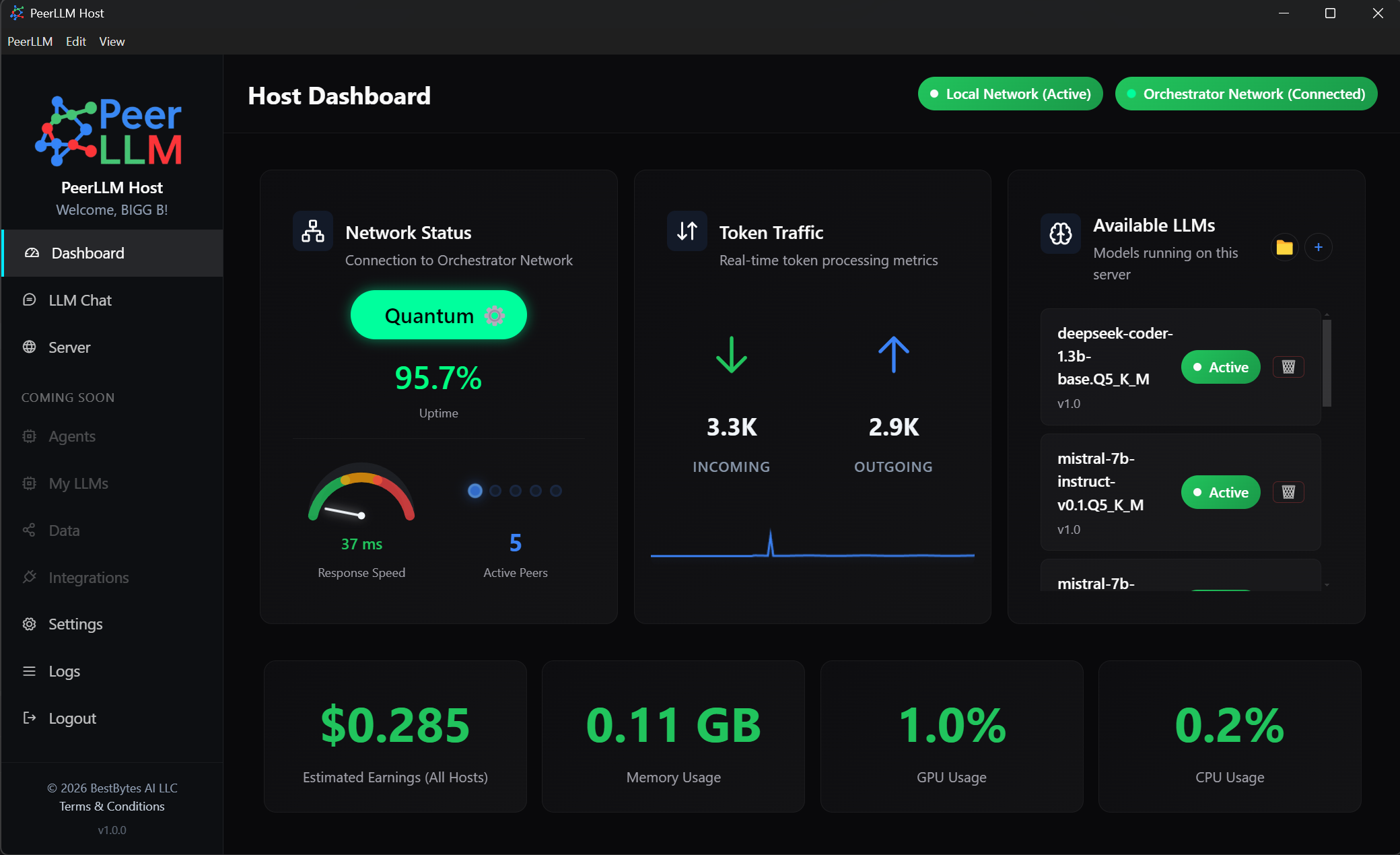
<p>Hosts can now clearly see what their machines are doing, how they are performing, and how they contribute to the network. This level of visibility is essential for building trust and confidence in a decentralized system.</p>

<hr />

<h2 id="the-economics">The Economics</h2>

<p>If this network is going to work long term, it must be fair in practice, not just in theory. The economic model has been designed to be simple, transparent, and aligned with hosts.</p>

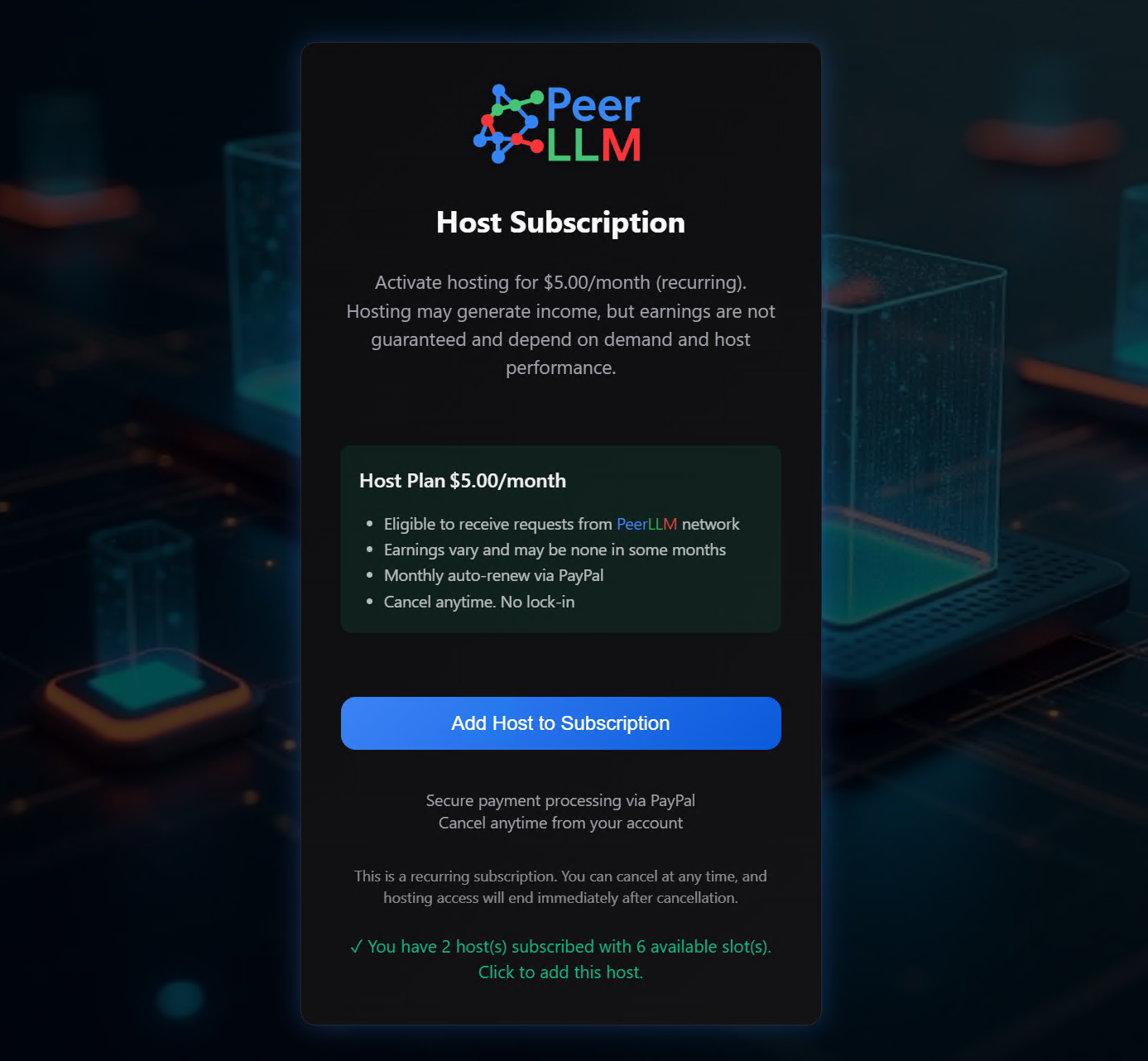
<p>Hosting costs $5 per month per machine. This subscription can be canceled at any time, and hosts have full control through their dashboard.</p>

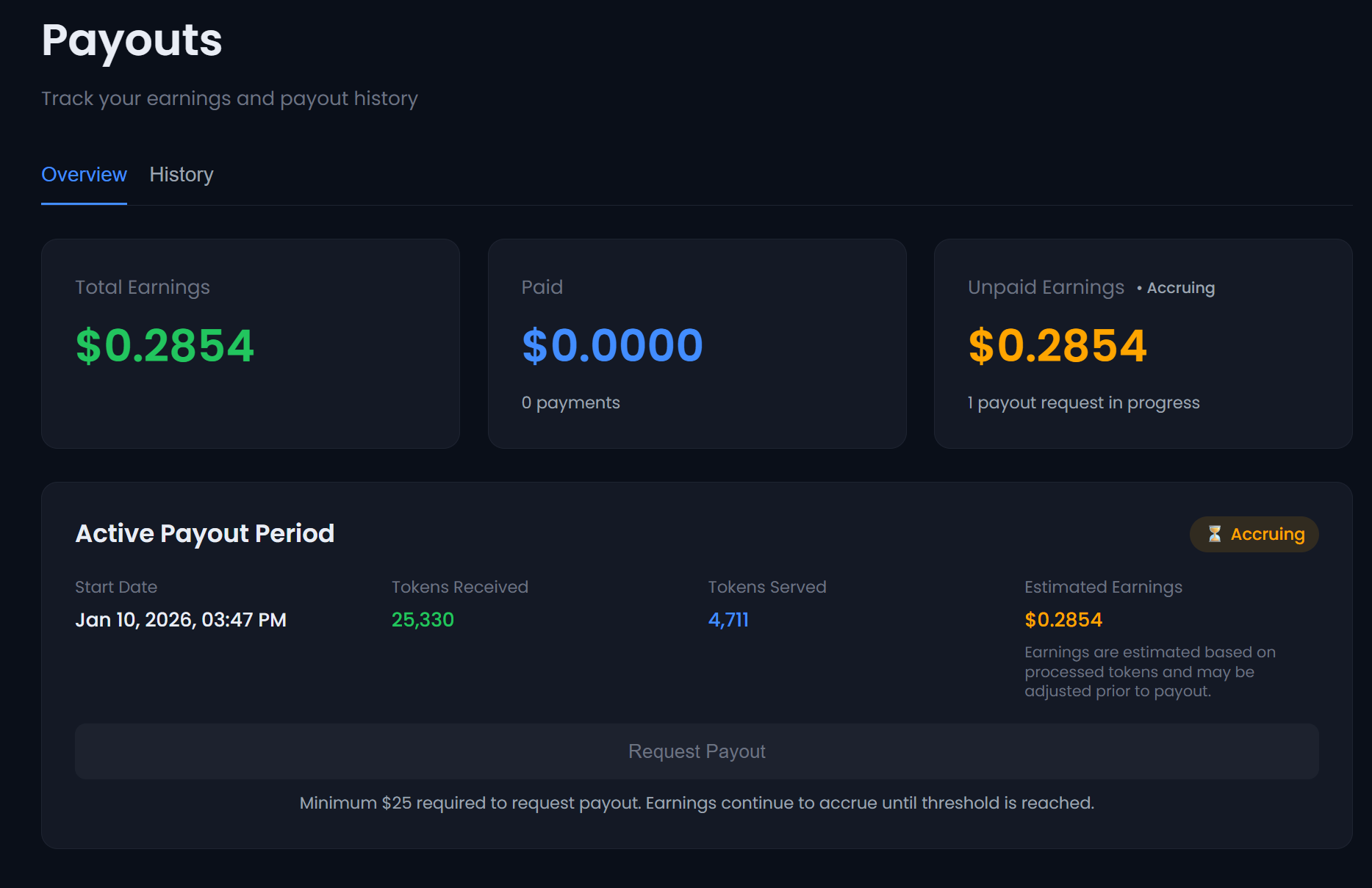
<p>Hosts can now see their estimated earnings, token usage, and activity across all their machines through both the PeerLLM application and the host portal.</p>

<p>Once a host reaches a minimum of $25, they can submit a payout request and receive funds via PayPal.</p>

<div class="post-image">
  <img src="/assets/images/v1.0.0-portal-earnings-payouts-view.png" alt="Purchasing tokens in PeerLLM Hosting portal." />
</div>

<p>The revenue model is intentionally transparent. PayPal takes its processing fees first, and PeerLLM takes 5% after those fees. For example, when $10 is processed, approximately $9.16 is received and around $9.11 is credited. At $100, approximately $97.01 is received. The guiding principle is simple: hosts should earn more than the platform itself.</p>

<hr />

<h2 id="access-is-now-invite-only">Access Is Now Invite Only</h2>

<p>With the release of v1.0.0, new host registrations are now locked and the network is operating in an invite-only mode.</p>

<p>Existing users who registered before this announcement can complete onboarding, sign the updated Host Agreement, and begin participating in the earning side of the network.</p>

<div class="post-image">
  <img src="/assets/images/v1.0.0-subscribing-host.png" alt="Purchasing tokens in PeerLLM Hosting portal." />
</div>

<p>This decision allows the network to grow in a controlled and responsible way. Supply must grow alongside demand, not ahead of it. This ensures stability, quality, and a better experience for both hosts and users.</p>

<hr />

<h2 id="network-cleanup-and-commitment">Network Cleanup and Commitment</h2>

<p>As part of this transition, inactive hosts have been cleaned up.</p>

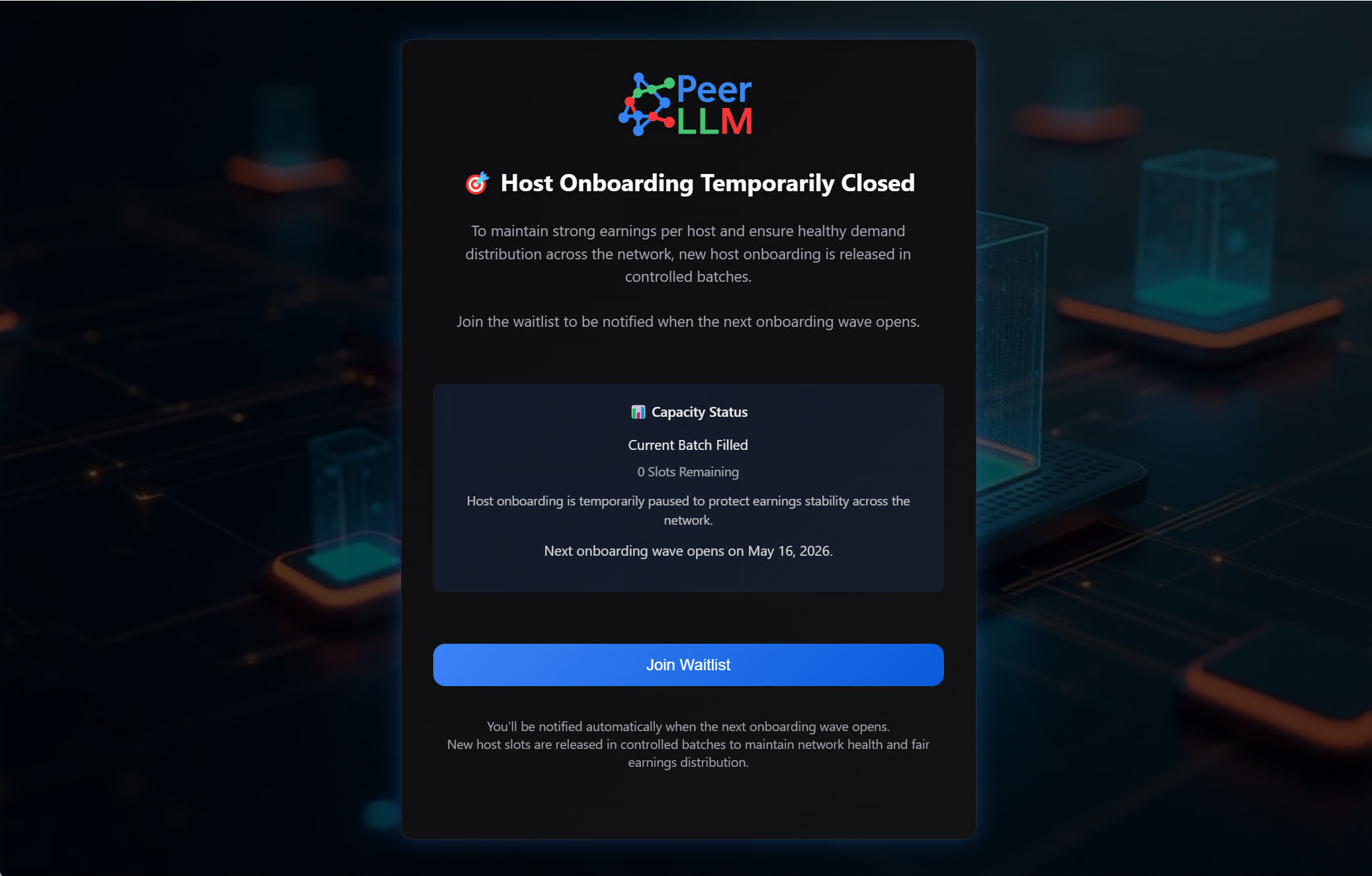
<p>Users who registered but did not keep their machines running during the pre-payment phase have had their host accounts temporarily suspended. This is not a punitive measure, but a necessary step to align the network with reliability and commitment.</p>

<div class="post-image">
  <img src="/assets/images/v1.0.0-join-waitlist-in-host.png" alt="Purchasing tokens in PeerLLM Hosting portal." />
</div>

<p>During the early stages, some hosts kept their systems running consistently, helping test the network without any guarantee of return. Others signed up but did not actively participate.</p>

<p>As we move into live payments, we need a dependable network to test the system end-to-end at scale. Priority is being given to those who contributed early and remained active.</p>

<p>The network will open again in the future, but for now, this phase is focused on stability and validation.</p>

<hr />

<h2 id="reality-and-expectations">Reality and Expectations</h2>

<p>It is important to be clear about expectations.</p>

<p>There is no guarantee of earnings.</p>

<p>PeerLLM is approximately six months old. The demand side of the network is still being built, and the economic model is still forming. Hosts may earn meaningful income, very little, or nothing at all.</p>

<p>In some cases, operational costs such as hardware, electricity, and internet may exceed earnings.</p>

<p>This is not passive income. This is participation in an emerging decentralized system.</p>

<hr />

<h2 id="a-living-economy">A Living Economy</h2>

<p>PeerLLM is not a static system. Pricing, token structures, subscriptions, and payout models may change over time.</p>

<p>These changes may increase or decrease costs and earnings, and in some cases may evolve entirely. This flexibility is necessary to find the right balance between host profitability, user affordability, and overall network sustainability.</p>

<p>The goal is not short-term stability. The goal is long-term viability.</p>

<hr />

<h2 id="who-is-using-peerllm-today">Who Is Using PeerLLM Today</h2>

<p>At this stage, the network is primarily used by the PeerLLM network health monitor, which continuously tests hosts and ensures reliability.</p>

<p>Developers are beginning to integrate through APIs, experimenting with building applications and services on top of the network.</p>

<p>Businesses are in early conversations and onboarding stages. Scaling real-world usage is the next major milestone.</p>

<p>Currently, most traffic is internal, but that is expected to change as adoption grows.</p>

<hr />

<h2 id="using-the-network--buying-tokens">Using the Network — Buying Tokens</h2>

<p>PeerLLM is not only for hosts. It is also available for users who want to run AI workloads on the network today.</p>

<p>To use the network, users purchase tokens. These tokens represent usage and allow workloads to be routed across hosts.</p>

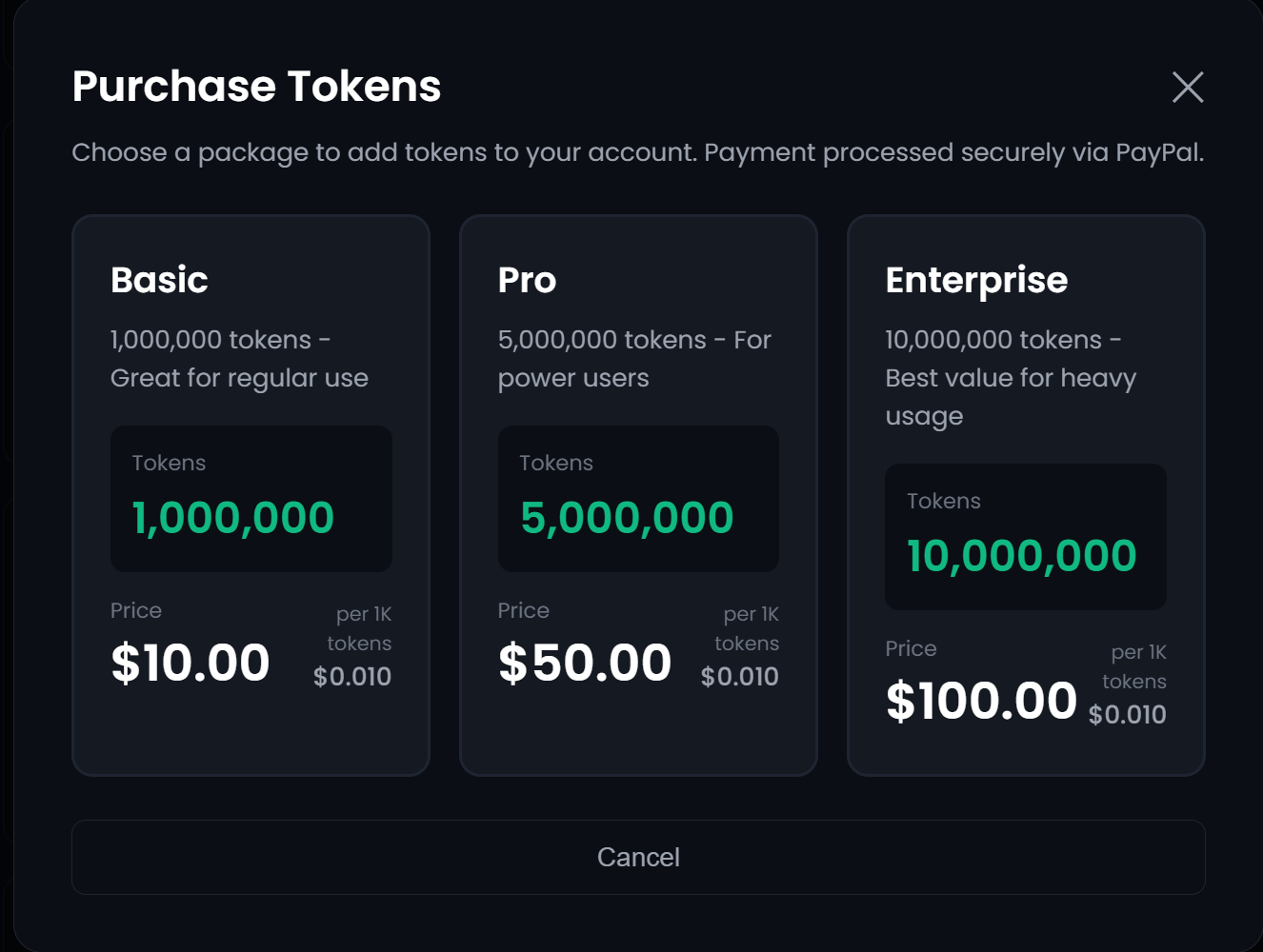
<p>We currently offer three packages. The Basic package includes 1 million tokens for $10. The Pro package includes 5 million tokens for $50. The Enterprise package includes 10 million tokens for $100.</p>

<p>Purchasing tokens is straightforward. Users can go to the PeerLLM portal, select a package, complete the payment, and immediately begin using the network.</p>

<div class="post-image">
  <img src="/assets/images/v1.0.0-portal-purchasing-tokens-view.png" alt="Purchasing tokens in PeerLLM Hosting portal." />
</div>

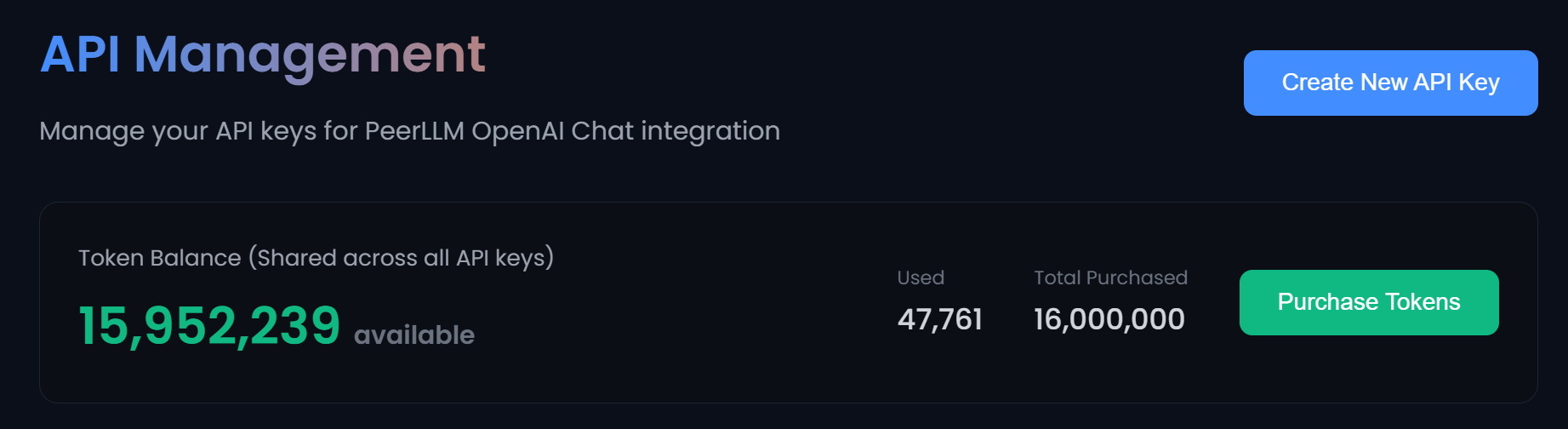
<p>Tokens serve as the bridge between users and hosts. They allow the network to measure demand, distribute work, and compensate hosts based on actual usage.</p>

<p>This marks an important shift. For the first time, users can pay to use the network, and hosts can earn from real demand. A network becomes real when someone is willing to pay to use it.</p>

<div class="post-image">
  <img src="/assets/images/v1.0.0-portal-api-management-view.png" alt="Purchasing tokens in PeerLLM Hosting portal." />
</div>

<hr />

<h2 id="what-comes-next">What Comes Next</h2>

<p>My focus now is on bringing demand into the network.</p>

<p>This includes meeting developers, working with startups, and onboarding businesses that can run real workloads on PeerLLM.</p>

<p>A network cannot exist with only supply or only demand. Both must grow together.</p>

<hr />

<h2 id="download-peerllm-v100">Download PeerLLM v1.0.0</h2>

<p>PeerLLM v1.0.0 is available today across all major platforms (windows, linux and mac).</p>

<p><a href="https://hosts.peerllm.com/downloads">Download the latest copy from the Host Portal</a>.</p>

<hr />

<h2 id="closing">Closing</h2>

<p>To everyone who joined early and kept their systems running, thank you.</p>

<div class="post-image">
  <img width="50%" src="/assets/images/v1.0.0-hassan-celebrating-with-thermalP.JPG" alt="Purchasing tokens in PeerLLM Hosting portal." />
</div>

<p>You did not just sign up. You contributed to making this system real.</p>

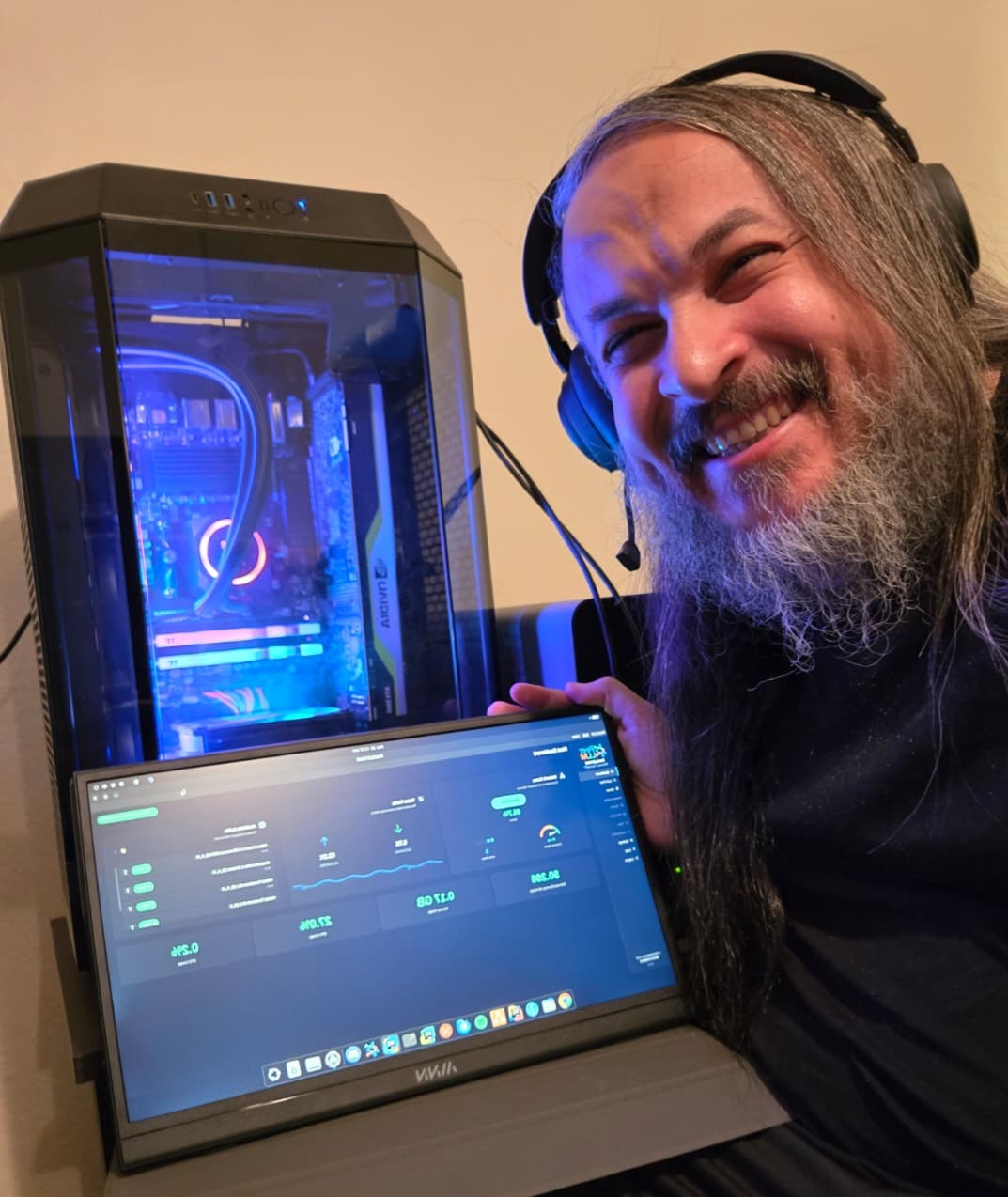
<p>Decentralization is not just an idea. It is behavior. And behavior is what we choose to reward.</p>

<p>PeerLLM v1.0.0 is live.</p>

<p>~ Hassan</p>]]></content><author><name>Hassan Habib</name></author><category term="PeerLLM" /><category term="Release" /><summary type="html"><![CDATA[The Moment PeerLLM is not an idea anymore. It is a working network where machines talk, compute, and get paid. For months, PeerLLM has been an idea rooted in a simple belief: AI should not belong to a handful of centralized data centers, and intelligence should not be controlled by a few entities. Your machine, sitting idle most of the day, should be able to participate in something meaningful and valuable.]]></summary></entry><entry><title type="html">PeerLLM v1.0.0 RC Release Update</title><link href="https://peerllm.github.io/peerllm/release/progress/2026/03/02/peerllm-v1.0.0-release-update.html" rel="alternate" type="text/html" title="PeerLLM v1.0.0 RC Release Update" /><published>2026-03-02T00:00:00+00:00</published><updated>2026-03-02T00:00:00+00:00</updated><id>https://peerllm.github.io/peerllm/release/progress/2026/03/02/peerllm-v1.0.0-release-update</id><content type="html" xml:base="https://peerllm.github.io/peerllm/release/progress/2026/03/02/peerllm-v1.0.0-release-update.html"><![CDATA[<p>On March 1st, I set an internal target for releasing PeerLLM v1.0.0. That date has arrived, and the public release has not yet happened. I want to be transparent about that. Rather than quietly shifting timelines, I think it’s important to explain exactly where things stand, what has been completed, and what is still being finalized.</p>

<p>This is not a stalled project. It is a nearly completed economic loop.</p>

<h2 id="0-host-subscriptions-complete">0/ Host Subscriptions [Complete]</h2>

<p>The host subscription system ($5/month) is complete and operational. It has been integrated, tested internally, and connected to host identity and authorization logic. The subscription layer represents the first foundational economic primitive of PeerLLM: commitment.</p>

<p>By introducing subscriptions, hosting is no longer just theoretical participation. It is intentional. Hosts commit to the network, contribute compute, and become part of a living infrastructure. The system is ready for wider controlled group testing, and I am expanding access gradually to ensure stability before broader rollout.</p>

<h2 id="1-payout-calculations-complete">1/ Payout Calculations [Complete]</h2>
<h3 id="payout-execution-in-progress">Payout Execution: [In Progress]</h3>

<p>The payout engine is fully built. Token accounting now works across incoming and outgoing traffic, across all hosts under a single user, and aggregates pending payout calculations accurately.</p>

<p>The Host Dashboard already reflects real token traffic and real accumulation. The earnings displayed are not placeholders—they are computed from actual usage flowing through the orchestrator network.</p>

<p>The remaining work is the final payout execution layer. In other words, the calculation engine is done, but I am finalizing the integration that enables actual fund disbursement so hosts can receive payments. This is the transition from simulated earnings to real settlement.</p>

<p>ETA for completing payout execution is within the next few days.</p>

<h2 id="2-api-token-purchases-in-progress">2/ API Token Purchases: [In Progress]</h2>

<p>On the consumer side, the API token purchase flow is still being finalized. This includes the full purchasing lifecycle: payment processing, credit allocation, usage deduction, and billing validation.</p>

<p>This is the final piece that closes the loop:</p>

<p>Consumers purchase tokens.<br />
Consumers use tokens.<br />
Hosts earn from token usage.<br />
Hosts get paid.</p>

<p>The purchase integration is expected to be completed this week.</p>

<h2 id="3-why-the-release-is-slightly-delayed">3/ Why the Release Is Slightly Delayed</h2>

<p>Payment systems are not UI features. They are trust infrastructure.</p>

<p>If a UI component breaks, it can be patched quickly. If a background job fails, it can be retried. But if payouts fail or accounting is inconsistent, trust breaks. and trust is the foundation of a decentralized network.</p>

<p>PeerLLM is not just a model runner. It is an economic system built around fairness and transparency. I would rather delay slightly than rush the most critical layer of the platform.</p>

<h2 id="4-where-peerllm-stands-today">4/ Where PeerLLM Stands Today</h2>

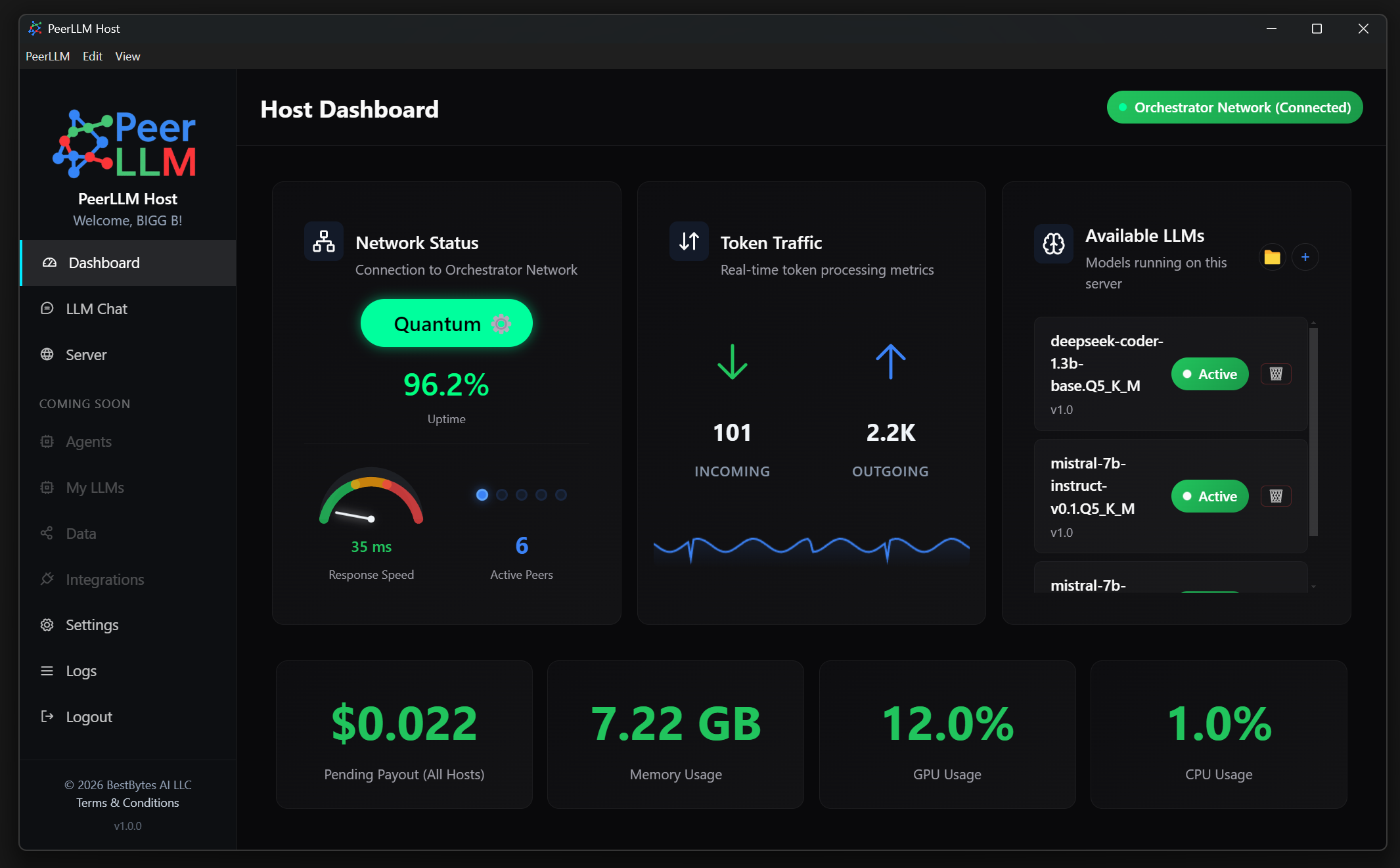
<p>PeerLLM is no longer an idea or a prototype. The host layer exists. Token accounting works. The subscription model is live. The payout engine calculates accurately. The orchestrator network is connected and processing real traffic.</p>

<div class="post-image">
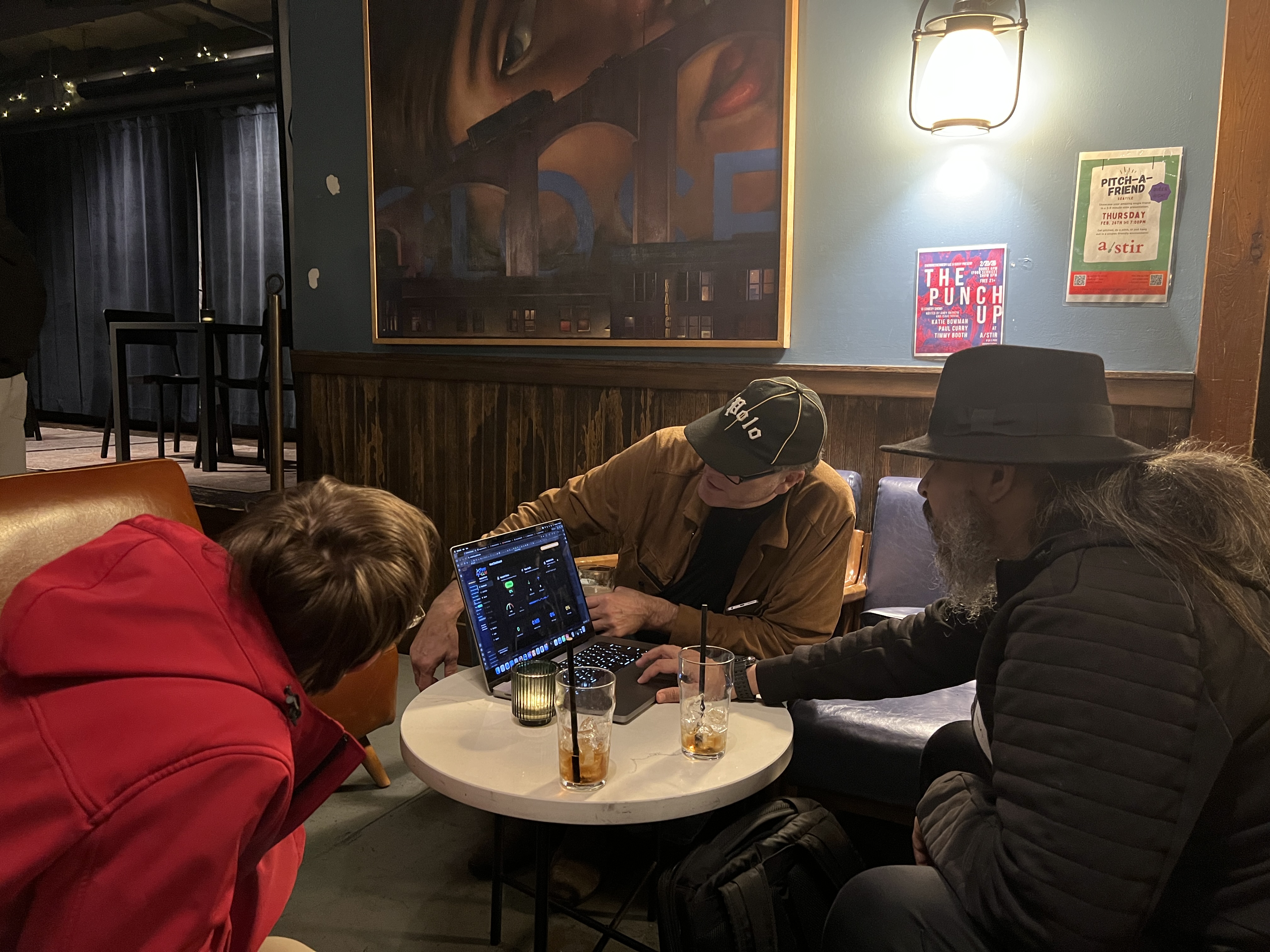
  <img src="/assets/images/peerllm-v1.0.0-rc-screenshot.png" alt="Seattle tech meetup discussion about decentralized AI" />
</div>

<p>What remains is the final integration that turns everything into a fully closed economic cycle.</p>

<p>v1.0.0 is not about marketing. It is about infrastructure. And infrastructure must be correct.</p>

<p>Thank you to everyone following the journey. The next update should include live payouts and a fully operational token purchase system.</p>

<p>— Hassan</p>]]></content><author><name>Hassan Habib</name></author><category term="PeerLLM" /><category term="Release" /><category term="Progress" /><summary type="html"><![CDATA[On March 1st, I set an internal target for releasing PeerLLM v1.0.0. That date has arrived, and the public release has not yet happened. I want to be transparent about that. Rather than quietly shifting timelines, I think it’s important to explain exactly where things stand, what has been completed, and what is still being finalized.]]></summary></entry><entry><title type="html">What Is PeerLLM?</title><link href="https://peerllm.github.io/peerllm/infrastructure/ai/2026/02/22/what-is-peerllm.html" rel="alternate" type="text/html" title="What Is PeerLLM?" /><published>2026-02-22T00:00:00+00:00</published><updated>2026-02-22T00:00:00+00:00</updated><id>https://peerllm.github.io/peerllm/infrastructure/ai/2026/02/22/what-is-peerllm</id><content type="html" xml:base="https://peerllm.github.io/peerllm/infrastructure/ai/2026/02/22/what-is-peerllm.html"><![CDATA[<h2 id="what-is-peerllm">What Is PeerLLM?</h2>

<p>PeerLLM is a hybrid distributed AI inference platform designed to reduce infrastructure centralization risk while delivering predictable performance and transparent pricing.</p>

<p>It routes AI requests across community-owned compute resources, with centralized safety enforcement and reliability controls. The goal is not to compete as the cheapest commodity API. The goal is to build resilient, distributed AI infrastructure that institutions and businesses can rely on long term.</p>

<hr />

<h2 id="the-problem-were-addressing">The Problem We’re Addressing</h2>

<p>Today, most AI inference is concentrated inside a small number of hyperscale data centers operated by a handful of vendors. This creates structural risks:</p>

<ul>
  <li>Infrastructure centralization</li>
  <li>Vendor lock-in</li>
  <li>Regional dependency</li>
  <li>Policy concentration</li>
  <li>Budget unpredictability</li>
  <li>Artificial throttling constraints</li>
  <li>System-wide outage blast radius</li>
</ul>

<p>Multi-cloud strategies diversify vendors — but they do not diversify infrastructure ownership.</p>

<p>PeerLLM introduces a different model.</p>

<hr />

<h2 id="how-peerllm-works">How PeerLLM Works</h2>

<p>PeerLLM combines:</p>

<ul>
  <li><strong>Community-owned compute (hosts)</strong></li>
  <li><strong>Centralized orchestration and safety enforcement</strong></li>
  <li><strong>Redundant routing for reliability</strong></li>
  <li><strong>Dedicated Host fallback for elasticity</strong></li>
  <li><strong>Transparent pricing governance</strong></li>
  <li><strong>Federated expansion as the network matures</strong></li>
</ul>

<h3 id="request-flow">Request Flow</h3>

<ol>
  <li>A prompt enters the orchestrator.</li>
  <li>It is evaluated for safety.</li>
  <li>Identifiers are removed.</li>
  <li>It gets broken into chunks.</li>
  <li>Chunks are routed redundantly to multiple hosts.</li>
  <li>Responses are evaluated using AI Content Safety.</li>
  <li>Only safe responses are returned.</li>
  <li>No prompt or response content is retained after delivery.</li>
  <li>Only minimal operational telemetry (latency, throughput) is collected.</li>
</ol>

<p>This model prioritizes:</p>

<ul>
  <li>Delivery reliability</li>
  <li>Safety enforcement</li>
  <li>Reduced data concentration</li>
  <li>Minimal retention</li>
  <li>Host accountability</li>
</ul>

<hr />

<h2 id="distributed--but-not-chaotic">Distributed — But Not Chaotic</h2>

<p>PeerLLM is distributed at the compute ownership layer.</p>

<p>It is centrally coordinated at the safety and pricing layer.</p>

<p>We are not building a permissionless protocol.<br />
We are building managed, resilient distributed infrastructure.</p>

<p>As the network grows, it evolves toward federation:</p>

<ul>
  <li>Local host communities</li>
  <li>Local capacity governance</li>
  <li>Shared global safety standards</li>
  <li>Shared pricing charter</li>
</ul>

<p>Federation activates only when objective thresholds are met (e.g., $50K/month revenue + 50 active hosts in a region).</p>

<p>This ensures growth is structural, not symbolic.</p>

<hr />

<h2 id="pricing-philosophy">Pricing Philosophy</h2>

<p>PeerLLM is not optimized for race-to-the-bottom token pricing.</p>

<p>It is optimized for predictable pricing and sustainable economics.</p>

<p>Our approach includes:</p>

<ul>
  <li>Transparent pricing structure</li>
  <li>Publicly documented pricing policy</li>
  <li>Margin discipline</li>
  <li>Host-first revenue distribution (95% to hosts)</li>
  <li>Cost-aligned adjustment mechanisms</li>
</ul>

<p>We aim to behave like infrastructure, not a speculative SaaS product.</p>

<p>For institutions such as schools and universities, predictable pricing enables long-term budgeting without surprise volatility.</p>

<hr />

<h2 id="host-model">Host Model</h2>

<p>Hosts contribute compute to the network and receive revenue participation.</p>

<p>Key principles:</p>

<ul>
  <li>No guaranteed earnings</li>
  <li>Early-stage participation</li>
  <li>Tiered host classes (standard and enterprise)</li>
  <li>Strike-based enforcement for safety violations</li>
  <li>No permanent bans for underperformance (only for rule violations)</li>
  <li>Local seat gating to balance supply and demand</li>
</ul>

<p>Enterprise clusters require higher reliability standards and may receive higher payouts.</p>

<hr />

<h2 id="reliability-model">Reliability Model</h2>

<p>PeerLLM uses:</p>

<ul>
  <li>Redundant host routing (parallel execution)</li>
  <li>AI Content Safety screening</li>
  <li>Host strike system</li>
  <li>Dedicated Host fallback when needed</li>
  <li>Capacity gating to manage utilization</li>
  <li>Tiered host infrastructure</li>
</ul>

<p>Customer experience prioritizes:</p>

<ul>
  <li>Enterprise-grade latency</li>
  <li>Delivery guarantees</li>
  <li>Minimal artificial throttling</li>
</ul>

<p>Fallback to dedicated host infrastructure is temporary and used to preserve reliability during spikes or host shortages.</p>

<hr />

<h2 id="security-model">Security Model</h2>

<p>PeerLLM reduces infrastructure concentration risk by:</p>

<ul>
  <li>Minimizing centralized data retention</li>
  <li>Separating identity from host processing</li>
  <li>Avoiding prompt/response storage</li>
  <li>Using centralized safety enforcement</li>
  <li>Limiting persistent routing traces</li>
</ul>

<p>We collect operational metrics (latency, throughput) but do not retain prompt or response content.</p>

<p>Compromise of a single host does not expose a centralized data store.</p>

<hr />

<h2 id="governance-vision">Governance Vision</h2>

<p>PeerLLM is designed as long-term infrastructure, not short-term product hype.</p>

<p>Our intention is to operate with:</p>

<ul>
  <li>A formal governance charter</li>
  <li>Transparent pricing commitments</li>
  <li>Defined margin discipline</li>
  <li>Local capacity governance</li>
  <li>Diverse leadership</li>
  <li>Federation triggers based on measurable thresholds</li>
</ul>

<p>PeerLLM aims to function more like a public utility than a speculative AI startup.</p>

<hr />

<h2 id="what-peerllm-is-not">What PeerLLM Is Not</h2>

<p>PeerLLM is not:</p>

<ul>
  <li>A get-rich-quick hosting scheme</li>
  <li>A permissionless crypto protocol</li>
  <li>A lowest-cost token arbitrage platform</li>
  <li>A hyperscaler replacement tomorrow</li>
  <li>A purely ideological experiment</li>
</ul>

<p>It is a pragmatic alternative infrastructure layer built to coexist with centralized AI providers while reducing systemic concentration risk.</p>

<hr />

<h2 id="who-its-for">Who It’s For</h2>

<p>PeerLLM is particularly aligned with:</p>

<ul>
  <li>Individuals wishing to use AI for any task</li>
  <li>Schools and universities</li>
  <li>Institutions requiring predictable budgets</li>
  <li>Businesses seeking infrastructure diversification</li>
  <li>Communities interested in local AI participation</li>
  <li>Organizations wary of vendor concentration</li>
</ul>

<hr />

<h2 id="the-core-idea">The Core Idea</h2>

<p>Multi-cloud diversifies vendors.</p>

<p>PeerLLM diversifies infrastructure ownership.</p>

<p>In a future where intelligence becomes infrastructure, infrastructure concentration becomes risk.</p>

<p>PeerLLM exists to introduce structural resilience into that future.</p>]]></content><author><name>Hassan Habib</name></author><category term="PeerLLM" /><category term="Infrastructure" /><category term="AI" /><category term="DistributedAI" /><category term="Federation" /><category term="Pricing" /><category term="Governance" /><category term="PublicUtility" /><summary type="html"><![CDATA[What Is PeerLLM?]]></summary></entry><entry><title type="html">Stress-Testing Decentralized AI in Seattle’s Tech Ecosystem</title><link href="https://peerllm.github.io/ai/decentralization/community/2026/02/19/peerllm-seattel-tour.html" rel="alternate" type="text/html" title="Stress-Testing Decentralized AI in Seattle’s Tech Ecosystem" /><published>2026-02-19T00:00:00+00:00</published><updated>2026-02-19T00:00:00+00:00</updated><id>https://peerllm.github.io/ai/decentralization/community/2026/02/19/peerllm-seattel-tour</id><content type="html" xml:base="https://peerllm.github.io/ai/decentralization/community/2026/02/19/peerllm-seattel-tour.html"><![CDATA[<h2 id="0-why-seattle">0/ Why Seattle?</h2>

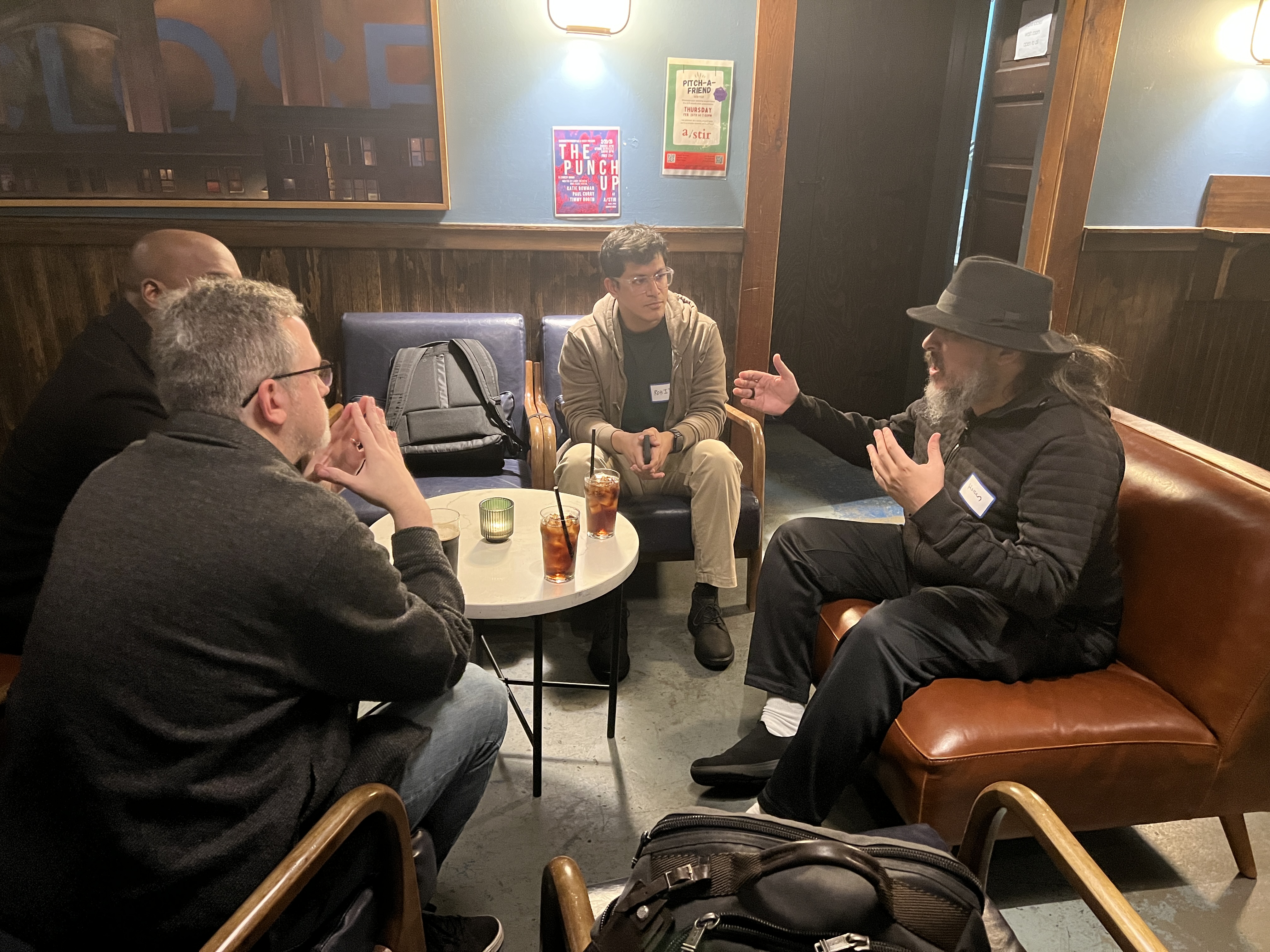
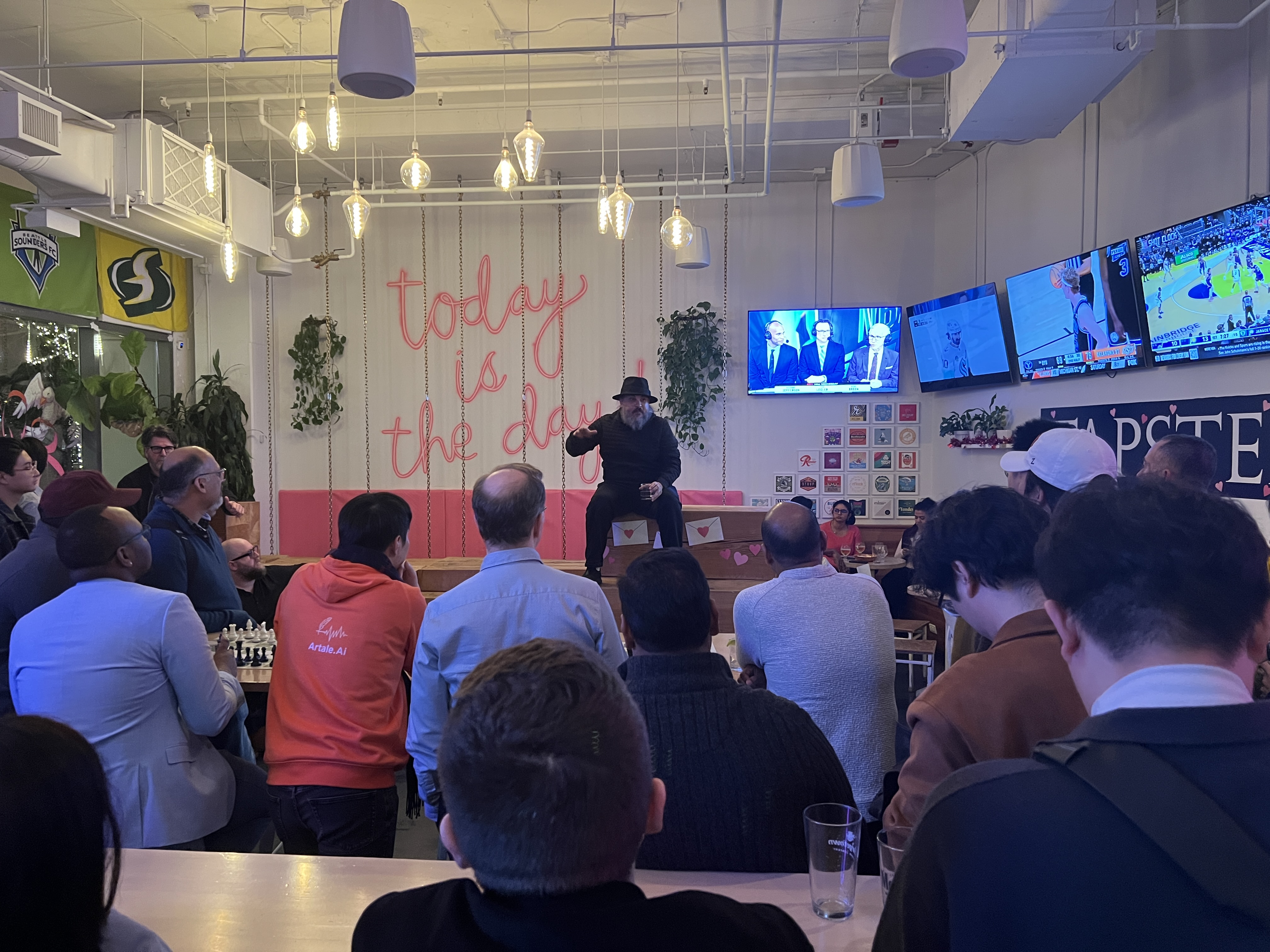
<p>Seattle has one of the most vibrant and intellectually demanding tech ecosystems in the world. It is home to brilliant engineers, seasoned architects, and product leaders who have built systems used by billions of people every single day.</p>

<p>At these events, we met people from big tech, startups, and even the non-profit sector. Conversations were thoughtful, direct, and deeply technical. As experienced engineers tend to be, the reaction pattern was remarkably consistent. It began with skepticism. Then came curiosity. Then realization. And finally, excitement.</p>

<p>Seattle was the perfect place to stress-test the idea of decentralized AI. If the idea can withstand scrutiny here  among people who understand distributed systems, infrastructure trade-offs, and scale  then it can withstand scrutiny anywhere.</p>

<div class="post-image">
  <img src="/assets/images/seattle-event-feb02.jpeg" alt="Seattle tech meetup discussion about decentralized AI" />
</div>

<hr />

<h2 id="1-first-impressions">1/ First-Impressions</h2>

<p>I worked intentionally to make sure my pitch takes no more than ten seconds. In rooms filled with engineers, clarity matters more than length.</p>

<p>The simplest way I describe PeerLLM is this:</p>

<blockquote>
  <p>“It’s Airbnb for your computer.”</p>
</blockquote>

<p>That usually earns a smile and an immediate mental model. Once that lands, I refine it in closer conversations:</p>

<blockquote>
  <p>“Do you use your computer 100% of the time? Probably not. What if the unused portion of that compute could be shared on a distributed AI network  and potentially generate passive income?”</p>
</blockquote>

<p>At that point, the idea clicks. People immediately visualize idle CPUs and GPUs being transformed into productive infrastructure. And once that visualization forms, the real questions begin.</p>

<div class="post-image">
  <img src="/assets/images/seattle-event-feb01.jpeg" alt="Seattle tech meetup discussion about decentralized AI" />
</div>

<hr />

<h2 id="2-questions">2/ Questions</h2>

<p>Those who leaned in  especially technical professionals  asked thoughtful and remarkably consistent questions. The skepticism was not dismissive; it was analytical. That made the conversations meaningful.</p>

<h3 id="20-does-it-actually-work">2.0/ Does It Actually Work?</h3>

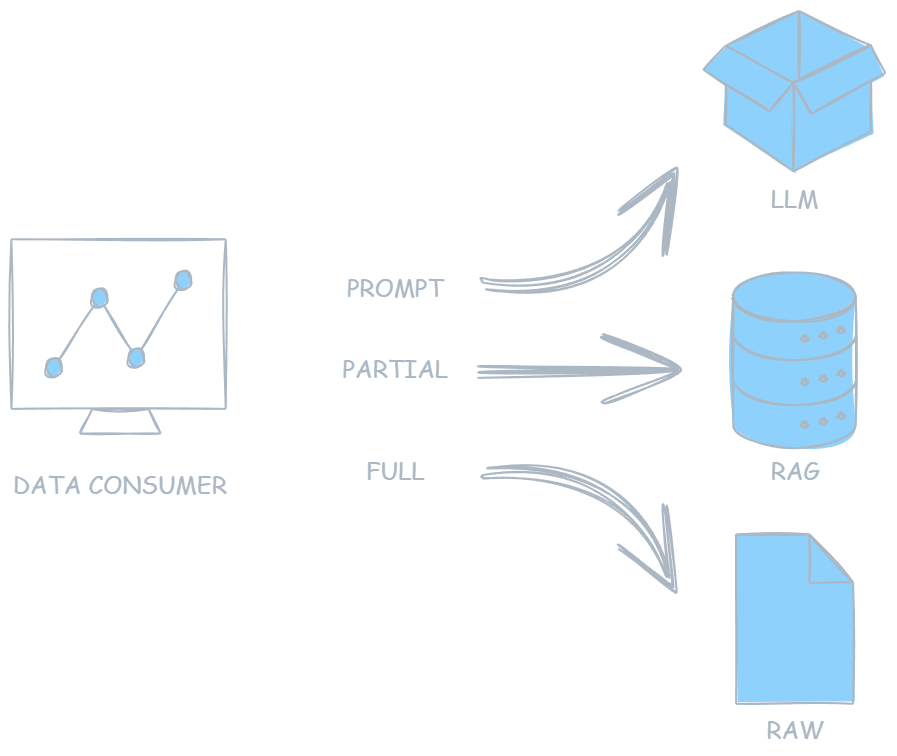
<p>PeerLLM is a decentralized AI compute network built around three essential personas: producers, hosts, and consumers.</p>

<p>Producers are developers who create high-quality LLMs. Hosts are individuals or organizations who contribute compute power by running those models on their machines. Consumers are developers or companies who use AI through our API.</p>

<p>I often describe it using a simple analogy: a farmer, a store owner, and a customer. The farmer grows the food. The store owner makes it available. The customer benefits from it. Each plays a distinct role, and the ecosystem functions only when all three participate.</p>

<p>Developers build models. Those models can be downloaded onto host machines and made available locally, within private networks, or globally through the PeerLLM network.</p>

<p>The generosity of the open-source AI community is what makes this possible. PeerLLM exists because open AI ecosystems exist. Our goal is to help close the economic loop  to allow people contributing compute or models to participate in the value being created.</p>

<p>That is an early step toward a more participatory AI economy.</p>

<hr />

<h3 id="21-what-about-security">2.1/ What About Security?</h3>

<p>Security is often the first serious technical concern  and rightly so.</p>

<p>In fast-paced event settings, the architecture diagram communicates the model more effectively than a long explanation.</p>

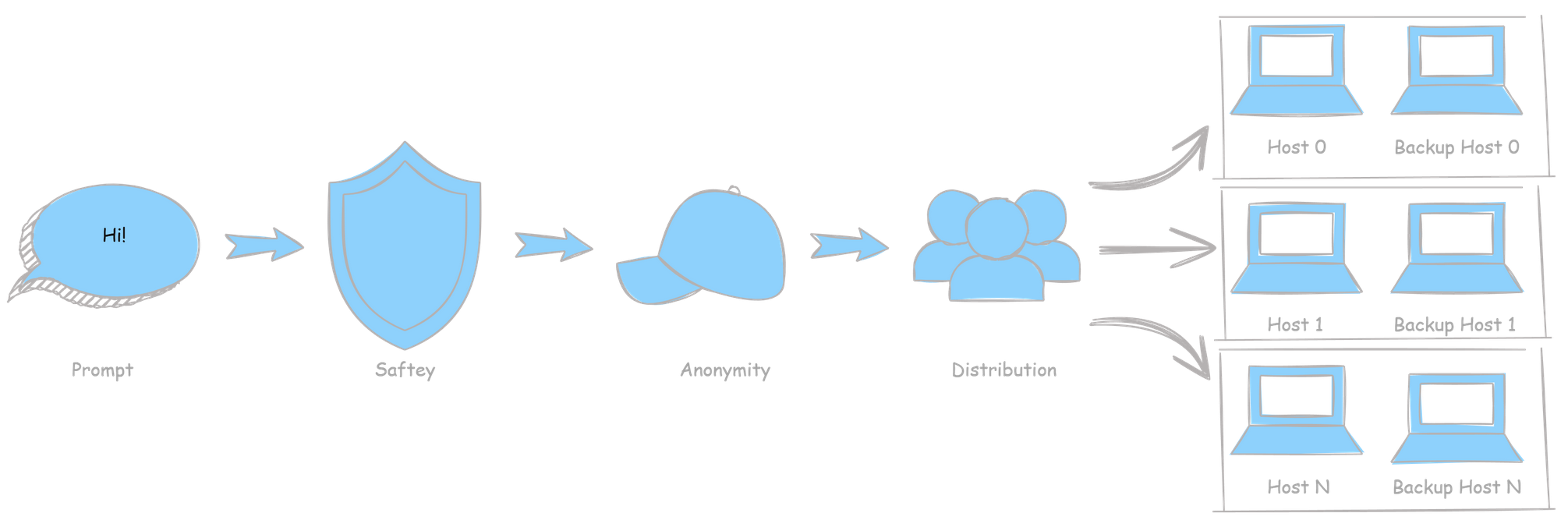
<p><img src="/assets/images/peerllm-architecture.png" alt="PeerLLM Decentralization Diagram" /></p>

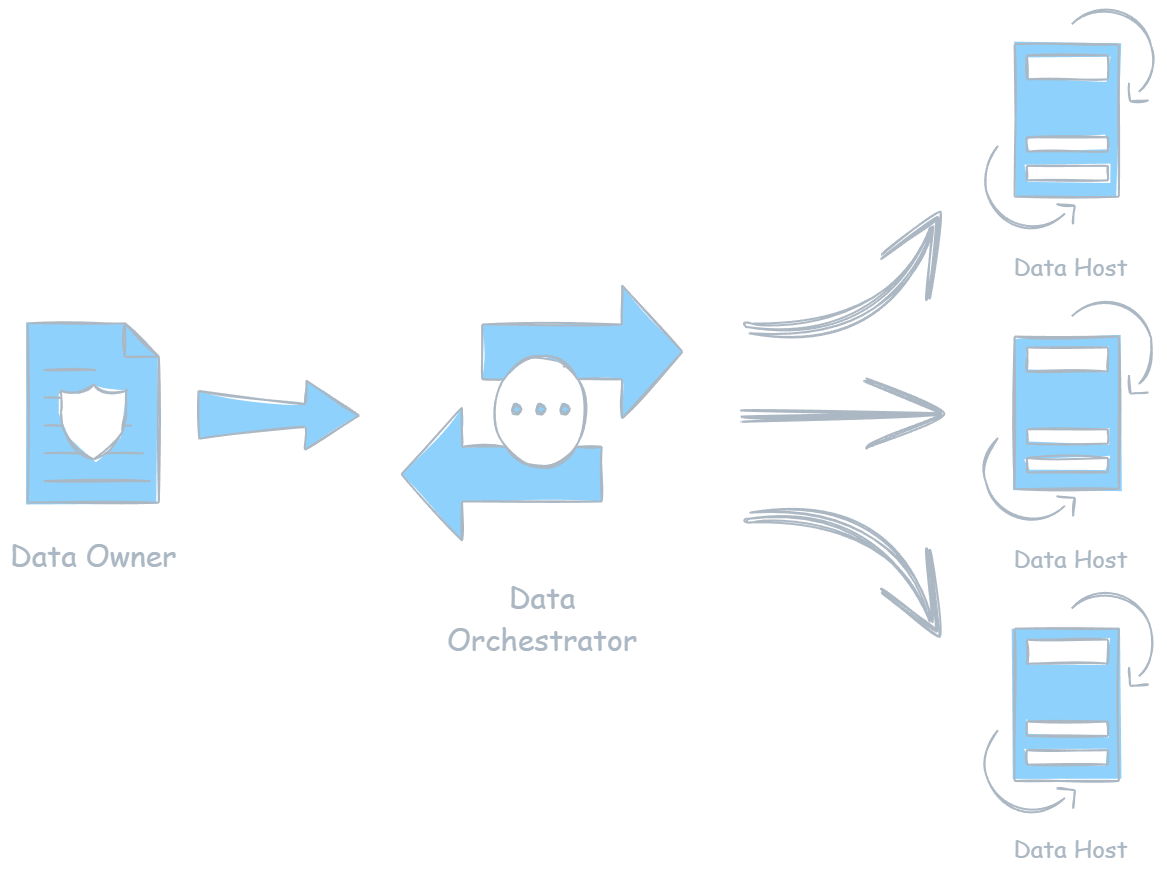
<p>At a high level, a user’s prompt does not travel directly to a host machine. Instead, it passes through multiple architectural layers, including security checks, anonymization, distribution logic, and orchestration.</p>

<p>Each host receives only a small, context-limited task. Individually, that task carries no meaningful or sensitive information. Only at the orchestration layer does the full response take shape.</p>

<p>This design enables decentralized inference while reducing risk exposure at any single node.</p>

<p>Incoming prompts are validated for safety. Outgoing responses are reviewed. Harmful content is blocked in alignment with PeerLLM’s usage policies. Anonymization layers strip away personal identifiers before distribution.</p>

<p>Security is not a feature added later. It is embedded in the architecture itself.</p>

<hr />

<h3 id="22-how-would-the-money-work">2.2/ How Would the Money Work?</h3>

<p>The economic model is intentionally simple and transparent.</p>

<p>PeerLLM charges $1 for every 100,000 tokens processed. Of that dollar, $0.95 goes directly to the host providing compute. Hosts pay a $5 monthly subscription fee to participate in the network.</p>

<p>In practical terms, a host can break even with approximately one 500,000-token session.</p>

<p>Interestingly, the calculator drew the most attention during conversations. It demonstrated preparedness. It showed that this was not just a philosophical idea  but a mathematically considered system.</p>

<p>Important: These numbers reflect scaled network conditions, not current performance.</p>

<div id="peerllm-calculator" style="
  background: linear-gradient(135deg, hsl(213 94% 14%), hsl(25 95% 20%));
  color: #fff;
  padding: 3rem;
  border-radius: 1.5rem;
  margin-top: 3rem;
  max-width: 700px;
  margin-left: auto;
  margin-right: auto;
  box-shadow: 0 0 25px rgba(0, 0, 0, 0.5);
  font-family: 'Inter', 'Roboto', sans-serif;
  text-align: center;
">

<img src="https://peerllm.com/src/assets/peerllm-logo-transparent.png" alt="PeerLLM Logo" style="width: 190px; height: 100px; margin-bottom: 1rem;" />

  <h2 style="font-size: 1.8rem; color: hsl(213 94% 68%); margin-bottom: 0.5rem;">
    PeerLLM Earnings Calculator
  </h2>

  <p style="color: hsl(220 20% 80%); margin-bottom: 2rem;">
    Adjust the sliders to explore your potential monthly earnings as a PeerLLM Host.
  </p>

  <div style="text-align: left; margin: 0 auto; max-width: 500px;">
    <label>Tokens per second: <span id="tokensPerSecondLabel" style="color: hsl(25 95% 60%);">10</span></label><br />
    <input type="range" id="tokensPerSecond" min="1" max="100" value="10" style="width:100%; margin-bottom:1.2rem;" />

    <label>Conversations in parallel: <span id="conversationsLabel" style="color: hsl(25 95% 60%);">5</span></label><br />
    <input type="range" id="conversations" min="1" max="10" value="5" style="width:100%; margin-bottom:1.2rem;" />

    <label>Number of Hosts: <span id="hostsLabel" style="color: hsl(25 95% 60%);">1</span></label><br />
    <input type="range" id="hosts" min="1" max="10" value="1" style="width:100%; margin-bottom:1.2rem;" />

    <label>Electricity cost per Host ($/month): <span id="electricityLabel" style="color: hsl(25 95% 60%);">25</span></label><br />
    <input type="range" id="electricity" min="0" max="100" value="25" style="width:100%; margin-bottom:1.2rem;" />

    <label>Internet cost per Host ($/month): <span id="internetLabel" style="color: hsl(25 95% 60%);">20</span></label><br />
    <input type="range" id="internet" min="0" max="100" value="20" style="width:100%; margin-bottom:1.2rem;" />
  </div>

  <hr style="margin: 2rem 0; border-color: hsl(213 94% 30%);" />

  <p style="color: hsl(220 20% 85%); font-size: 0.95rem;">
    <strong>Subscription cost:</strong> $5/month per Host (fixed)
  </p>

  <div style="
    background: hsl(213 94% 12%);
    padding: 1.5rem;
    border-radius: 1rem;
    margin-top: 1rem;
    box-shadow: inset 0 0 10px rgba(255,255,255,0.1);
  ">
    <h3 style="font-size: 1.6rem; color: hsl(25 95% 60%); margin: 0;">
      Estimated Monthly Earnings:
    </h3>
    <p style="font-size: 2rem; font-weight: bold; margin: 0.5rem 0 0;">
      $<span id="earnings">0</span>
    </p>
  </div>

<p style="margin-top: 2rem; font-size: 0.9rem; color: hsl(220 20% 75%); text-align: left; line-height: 1.6;">
  <strong>Disclaimer:</strong><br />
  This calculator is provided for informational and educational purposes only. The values shown are 
  <strong>approximations</strong> based on theoretical calculations. Actual earnings may vary significantly depending on 
  uptime, hardware performance, consumer demand, and network conditions.<br /><br />
  PeerLLM is currently in <strong>experimental and pre-release</strong> stages and does not generate revenue at this time. 
  No earnings, payouts, or performance results are guaranteed until after the official production release of the PeerLLM 
  Orchestration Network.<br /><br />
  By using this calculator, you acknowledge that it does not constitute a financial promise, offer, or guarantee of income, 
  and all results should be treated as illustrative estimates only.
</p>

  <script>
    const tokensPerSecond = document.getElementById('tokensPerSecond');
    const conversations = document.getElementById('conversations');
    const hosts = document.getElementById('hosts');
    const electricity = document.getElementById('electricity');
    const internet = document.getElementById('internet');
    const earningsEl = document.getElementById('earnings');

    const labels = {
      tokensPerSecond: document.getElementById('tokensPerSecondLabel'),
      conversations: document.getElementById('conversationsLabel'),
      hosts: document.getElementById('hostsLabel'),
      electricity: document.getElementById('electricityLabel'),
      internet: document.getElementById('internetLabel')
    };

    const update = () => {
      const tps = parseFloat(tokensPerSecond.value);
      const conv = parseInt(conversations.value);
      const h = parseInt(hosts.value);
      const elec = parseFloat(electricity.value);
      const net = parseFloat(internet.value);

      const tokensPerMonth = tps * 3600 * 24 * 30 * conv * h;
      const gross = tokensPerMonth / 100000; // 100k tokens = $1
      const costPerHost = elec + net + 5; // includes subscription
      const totalCost = costPerHost * h;
      const netIncome = gross - totalCost;

      earningsEl.textContent = netIncome.toFixed(2);
      labels.tokensPerSecond.textContent = tps;
      labels.conversations.textContent = conv;
      labels.hosts.textContent = h;
      labels.electricity.textContent = elec;
      labels.internet.textContent = net;
    };

    document.querySelectorAll('#peerllm-calculator input').forEach(el => el.addEventListener('input', update));
    update();
  </script>
</div>

<p>The model is designed so that hosts earn more than the platform. This is not about maximizing margins. It is about building participation and creating incentives that align with decentralization.</p>

<p>The goal is not extraction. The goal is distribution.</p>

<div class="post-image">
  <img src="/assets/images/seattle-event-feb04.jpeg" alt="Seattle tech meetup discussion about decentralized AI" />
</div>

<hr />

<h3 id="23-what-stage-are-you-in">2.3/ What Stage Are You In?</h3>

<p>The core distributed inference system is operational end-to-end. The current focus is production hardening and payment integration ahead of general availability.</p>

<p>The next iteration focuses on payment infrastructure. We are integrating PayPal to manage host subscriptions, host payouts, and consumer billing plans. These components are essential as we prepare for a general availability release of v1.0.0.</p>

<p>Our target launch date is March 1st.</p>

<hr />

<h3 id="24-what-do-you-need-today-to-keep-going">2.4/ What Do You Need Today To Keep Going?</h3>

<p>This was the most common and encouraging question I received.</p>

<p>At every event, we are looking for three types of people: hosts, developers, and integrators.</p>

<p>Hosts are individuals willing to download the application, sign up, and run LLMs on their local machines. They form the distributed backbone of the network.</p>

<p>Developers are model creators who want distribution and monetization opportunities. We aim to build an AI economy where models can be sold, subscribed to, and deployed across decentralized infrastructure.</p>

<p>Integrators and consumers are companies and developers who simply need AI for daily operations. PeerLLM supports the OpenAI API standard, making integration straightforward across existing applications and SDKs.</p>

<p>Developers can build on decentralized AI infrastructure without changing their workflow.</p>

<div style="position: relative; width: 100%; padding-bottom: 56.25%; height: 0; margin: 2rem 0;">
  <iframe src="https://www.youtube.com/embed/vBivYwKv0mM?si=EjOpWoNbzJyilDgr" title="YouTube video player" style="position: absolute; top: 0; left: 0; width: 100%; height: 100%; border: 0;" allowfullscreen="">
  </iframe>
</div>

<hr />

<h2 id="3-real-feedback-from-the-community">3/ Real Feedback from the Community</h2>

<p>One of the most meaningful outcomes of this tour was hearing thoughtful public feedback from engineers who engaged deeply with the idea.</p>

<p>The reflections were not blind optimism. They were analytical and balanced. They highlighted the opportunity tapping into unused global compute, creating alternative economic participation models, and reducing total reliance on centralized hyperscalers.</p>

<p>They also raised hard questions about long-term incentives, latency, performance at scale, and economic sustainability in an AI-dominated world.</p>

<p>Those are not trivial concerns. They are foundational questions.</p>

<p>And that is precisely why these conversations matter.</p>

<div style="
  display: flex;
  justify-content: center;
  margin: 4rem 0;
  padding: 2rem;
  background: #f9fafb;
  border-radius: 20px;
  box-shadow: 0 15px 40px rgba(0,0,0,0.08);
">
  <iframe src="https://www.linkedin.com/embed/feed/update/urn:li:share:7425984957770047489" height="900" width="504" frameborder="0" allowfullscreen="" title="Embedded LinkedIn Post" style="border-radius: 12px;">
  </iframe>
</div>

<p>Decentralization is not interesting because it sounds idealistic.</p>

<p>It is interesting because serious engineers are beginning to ask whether alternative infrastructure models are not just possible but necessary.</p>

<hr />

<h2 id="4-the-bigger-shift">4/ The Bigger Shift</h2>

<p>One interesting pattern from these events was realizing that PeerLLM is not alone in exploring decentralized AI infrastructure.</p>

<p>For example, companies like <a href="https://reenvision.ai/">ReEnvision AI</a> are thinking about decentralized compute from a business perspective helping organizations rethink how AI workloads can be distributed rather than fully centralized.</p>

<p>The approaches may differ. The target audiences may differ. But the underlying signal is the same:</p>

<p>People are beginning to question whether hyperscaler-only infrastructure is the inevitable future of AI.</p>

<p>When independent builders start converging toward similar architectural ideas, it usually means something structural is happening.</p>

<p>Decentralization is not just an ideology.</p>

<p>It is becoming a design option.</p>

<hr />

<h2 id="final-thought">Final Thought</h2>

<p>What fascinated me most during this tour was not just the depth of the technical discussion. It was the consistency of the reaction.</p>

<p>PeerLLM, as an idea, was immediately understood. People grasped the value within seconds. The concept of unused compute becoming productive infrastructure did not require persuasion. It clicked.</p>

<p>Very few people walked away. Almost everyone stayed. And almost everyone had serious questions.</p>

<p>Questions about incentives.<br />
Questions about latency.<br />
Questions about sustainability.<br />
Questions about economic structure in an AI-driven future.</p>

<p>No one dismissed the idea outright.</p>

<p>That matters.</p>

<div class="post-image">
  <img src="/assets/images/seattle-event-feb07.JPG" alt="Seattle tech meetup discussion about decentralized AI" />
</div>

<p>In a future where intelligence becomes infrastructure, infrastructure becomes power. And power if left concentrated shapes opportunity, access, and economic participation.</p>

<p>But infrastructure can also be distributed.</p>

<p>It can be owned locally.<br />
It can be shared.<br />
It can be participatory.</p>

<p>PeerLLM is not just a product. It is an experiment in economic alignment. It is an exploration of whether the AI economy can be participatory rather than purely centralized.</p>

<p>Movements do not begin with perfection. They begin with possibility.</p>

<p>And in room after room, across conversations that began with skepticism and ended with engagement, one thing became clear:</p>

<p>Decentralized AI is not fringe.</p>

<p>It is timely.</p>

<p>We are building an alternative.</p>

<p>One host.<br />
One developer.<br />
One integrator.<br />
One conversation at a time.</p>

<hr />

<h2 id="a-personal-note">A Personal Note</h2>

<p>Before closing, I want to acknowledge someone who made this entire tour possible.</p>

<p>My co-founder and partner, Kailu, drove to every single event, helped discover and organize them, captured the photos, and supported every conversation along the way. More importantly, he believes deeply in the mission and long-term vision behind PeerLLM.</p>

<p>Building something ambitious requires more than technical architecture. It requires conviction. It requires someone willing to show up consistently  even when the outcome is uncertain.</p>

<p>I’m grateful to be building this alongside someone who shares that belief.</p>

<div class="post-image">
  <img src="/assets/images/kailu-and-hassan.png" alt="Seattle tech meetup discussion about decentralized AI" />
</div>]]></content><author><name>Hassan Habib</name></author><category term="AI" /><category term="Decentralization" /><category term="Community" /><category term="PeerLLM" /><category term="Seattle" /><category term="DistributedAI" /><category term="Startups" /><summary type="html"><![CDATA[0/ Why Seattle?]]></summary></entry><entry><title type="html">PeerLLM’s Next Phase: Decentralized Data as the Foundation of Intelligence</title><link href="https://peerllm.github.io/peerllm/update/2025/12/28/peerllm-data-phase.html" rel="alternate" type="text/html" title="PeerLLM’s Next Phase: Decentralized Data as the Foundation of Intelligence" /><published>2025-12-28T00:00:00+00:00</published><updated>2025-12-28T00:00:00+00:00</updated><id>https://peerllm.github.io/peerllm/update/2025/12/28/peerllm-data-phase</id><content type="html" xml:base="https://peerllm.github.io/peerllm/update/2025/12/28/peerllm-data-phase.html"><![CDATA[<p>PeerLLM was never meant to be just another way to run LLMs.</p>

<p>Decentralized compute was the first phase. It was a foundational phase, but it was never the destination.</p>

<p>From the very beginning, PeerLLM was designed around a broader vision: building a fully decentralized intelligence ecosystem that does not just think, but remembers, decides, and acts, while remaining owned by the people and systems that power it.</p>

<p>Today, PeerLLM has a strong footing in the LLM compute phase. Individuals can host models, run inference locally or across private networks, and participate in decentralized compute without relying on centralized cloud providers.</p>

<p>That phase proved something critical:</p>

<blockquote>
  <p>Intelligence does not need to live in massive data centers to be useful.</p>
</blockquote>

<p>But intelligence without data is shallow.<br />
And intelligence without direction is dangerous.</p>

<p>This post introduces the Data phase and explains why it is essential to the long-term PeerLLM vision.</p>

<hr />

<h2 id="the-tri-nature-of-intelligence-data-decision-direction">The Tri-Nature of Intelligence: Data, Decision, Direction</h2>

<p>PeerLLM is built on a simple but powerful idea: intelligence has three inseparable parts.</p>

<ul>
  <li><strong>Data</strong>: knowledge, experience, signals, observations</li>
  <li><strong>Decision</strong>: reasoning and inference through LLMs and compute</li>
  <li><strong>Direction</strong>: intent, action, and execution</li>
</ul>

<hr />

<div style="position: relative; width: 100%; padding-bottom: 56.25%; height: 0; margin: 2rem 0;">
  <iframe src="https://www.youtube.com/embed/BMNi6lVNGas?si=s1DYIPZbTYSTZnHx" title="YouTube video player" style="position: absolute; top: 0; left: 0; width: 100%; height: 100%; border: 0;" allow="accelerometer; autoplay; clipboard-write; encrypted-media; gyroscope; picture-in-picture; web-share" referrerpolicy="strict-origin-when-cross-origin" allowfullscreen="">
  </iframe>
</div>

<hr />

<p>Compute alone only solves decision making.</p>

<p>True intelligence requires all three parts working together.</p>

<p>The long-term goal of PeerLLM is to cover:</p>
<ul>
  <li><strong>Data</strong> (this phase)</li>
  <li><strong>Decision</strong> (compute and LLMs)</li>
  <li><strong>Direction</strong> (abilities, actions, execution)</li>
</ul>

<p>Together, these form a decentralized intelligence ecosystem capable of powering billions of daily operations, while also enabling billions of people and systems to earn income, sustain themselves, and evolve in a new AI-driven economy.</p>

<hr />

<h2 id="why-peerllm-cares-about-data">Why PeerLLM Cares About Data</h2>

<p>The modern AI ecosystem has a structural problem.<br />
Data is extracted, centralized, and monetized without meaningful consent.</p>

<p>Creators spend years producing knowledge only to see it absorbed into models that:</p>
<ul>
  <li>provide no attribution</li>
  <li>offer no royalties</li>
  <li>give no control</li>
  <li>and often compete directly with the original creators</li>
</ul>

<p>PeerLLM’s data phase is about correcting that. Not by centralizing ownership, but by ensuring no single entity ever owns the full data.</p>

<hr />

<h2 id="manufacturing-data-humans-and-systems-as-sources-of-truth">Manufacturing Data: Humans and Systems as Sources of Truth</h2>

<p>In PeerLLM, data can be manufactured by people or systems.</p>

<ul>
  <li>Humans contributing expertise and lived experience</li>
  <li>Sensors collecting agricultural, environmental, or industrial data</li>
  <li>Automated systems producing continuous streams of information</li>
</ul>

<p>Data contribution can be:</p>
<ul>
  <li><strong>Triggered</strong> (requested knowledge)</li>
  <li><strong>Voluntary</strong> (shared expertise or datasets)</li>
  <li><strong>Automatic</strong> (continuous system-generated data)</li>
</ul>

<p>Regardless of how data enters the network, the origin is always known.<br />
The contributor is marked as the source of truth.</p>

<p>This phase comes with real challenges:</p>
<ul>
  <li>How do we verify expertise?</li>
  <li>How do we detect originality?</li>
  <li>How do we prevent copyrighted or stolen material?</li>
</ul>

<p>These are not afterthoughts. They are core problems this phase is designed to solve.</p>

<hr />

<h2 id="hosting-data-fragmentation-by-design">Hosting Data: Fragmentation by Design</h2>

<p>Once data is contributed, it is never stored whole.</p>

<p>It is:</p>
<ul>
  <li>Hashed</li>
  <li>Split into meaningless fragments</li>
  <li>Distributed across many independent hosts</li>
</ul>

<p>No single machine, including the contributor’s, can reconstruct the data alone.</p>

<h3 id="three-hosting-layers">Three Hosting Layers</h3>

<ol>
  <li>
    <p><strong>The Contributor</strong><br />
The original source of truth.</p>
  </li>
  <li>
    <p><strong>The Network Hosts</strong><br />
Independent participants holding tiny, context-free fragments.</p>
  </li>
  <li>
    <p><strong>The Orchestrator (Stitcher)</strong><br />
A system that knows how to temporarily assemble fragments only on demand.</p>
  </li>
</ol>

<p>Meaning exists only ephemerally during a request and is never permanently centralized.</p>

<hr />

<h2 id="data-flow-and-orchestration">Data Flow and Orchestration</h2>

<p><img src="/assets/images/data-flow-diagram.png" alt="PeerLLM Data Orchestration Flow" /></p>

<p>This diagram illustrates how:</p>
<ul>
  <li>Data originates from a contributor</li>
  <li>Is fragmented and distributed across the network</li>
  <li>Is temporarily stitched together for consumption</li>
  <li>Then immediately released back into fragments</li>
</ul>

<p>If any host is compromised:</p>
<ul>
  <li>Nothing meaningful is exposed</li>
  <li>No dataset can be reconstructed</li>
  <li>No centralized target exists</li>
</ul>

<hr />

<h2 id="consuming-data-three-governed-forms">Consuming Data: Three Governed Forms</h2>

<p>Data in PeerLLM can be consumed in three distinct ways, all governed and auditable.</p>

<h3 id="1-raw-data-consumption">1. Raw Data Consumption</h3>
<p>Direct access to raw text or raw signals for human review or specialized processing. Access is permissioned and tracked to reduce leakage.</p>

<h3 id="2-llm--fine-tuning-consumption">2. LLM / Fine-Tuning Consumption</h3>
<p>Data can be used to train or fine-tune language models, embedding contributor knowledge while preserving attribution and compensation.</p>

<h3 id="3-rag-retrieval-augmented-generation">3. RAG (Retrieval-Augmented Generation)</h3>
<p>Data is retrieved dynamically. Only the fragments required to answer a question are assembled, used, and immediately released.</p>

<p><img src="/assets/images/data-consumption-diagram.png" alt="PeerLLM Data Consumption Flow" /></p>

<p>Each mode supports:</p>
<ul>
  <li>Attribution</li>
  <li>Royalties or flat-fee compensation</li>
  <li>Policy enforcement</li>
  <li>Regulatory compliance</li>
</ul>

<hr />

<h2 id="recognizing-the-challenges-ahead">Recognizing the Challenges Ahead</h2>

<p>This phase introduces hard problems, and we acknowledge them openly.</p>

<ul>
  <li><strong>Manufacturing challenges:</strong> authenticity and expertise validation</li>
  <li><strong>Hosting challenges:</strong> detecting illicit data before fragmentation</li>
  <li><strong>Consumption challenges:</strong> preventing misuse or off-network leakage</li>
</ul>

<p>No system is perfect.<br />
PeerLLM is designed to minimize harm by architecture, not by trust.</p>

<hr />

<h2 id="the-bigger-picture">The Bigger Picture</h2>

<p>Decentralized compute proved intelligence can be owned.<br />
Decentralized data ensures knowledge can be shared without being stolen.<br />
The next phase, decentralized direction, will ensure intelligence acts only where it is trusted.</p>

<p>Together, these phases form more than a platform.</p>

<blockquote>
  <p>A decentralized intelligence ecosystem that allows people and systems to participate, earn, and evolve without surrendering control to centralized power.</p>
</blockquote>

<p>This is the future PeerLLM is building.</p>

<p>And this is only the beginning.</p>]]></content><author><name>Hassan Habib</name></author><category term="peerllm" /><category term="update" /><summary type="html"><![CDATA[PeerLLM was never meant to be just another way to run LLMs.]]></summary></entry></feed>